Saturday, June 30, 2007
Rainy Days and Mondays - unplugged
Their first set, lasting thirty minutes, began with Bob Marley's Waiting In Vain and was accompanied by Basil Gabbidon on acoustic guitar. The intimacy of the venue allowed the duo to sing without microphones and seven of their ten songs were backed by Basil and his guitar, the remainder were sung to a backing tape. Still The One, Saving All My Love, Feel Like Making Love, Walk On By and a brilliant rendition of Fleetwood Mac's Go Your Own Way concluded the opening set. The easy-listening love song themes continued after a short break with For The Love, Keep It Like It Is (Don't Know Why) and Killing Me Softly before a Leonie/Basil penned track called Sincerity closed the performance to well-deserved applause.
The girls sang beautifully, the harmonies were precise and they complemented each other perfectly - Leonie's voice has a rare quality indeed, while Indigo, who was struggling with the remnants of a heavy cold, is a versatile and talented vocalist - and they show exceptional promise as a duo that will develop and grow with more appearances under their belt. Watch out for Rainy Days and Mondays at a venue near you soon. You can also catch them as part of the Gabbidon/ReggaeRockz band, set to play a series of dates in and around Birmingham over the next few months.
Links: Indigo MySpace, Leonie Moore, Leonie MySpace.
Friday, June 29, 2007
Arrival & Pursat : 2006
I've just completed penning my 2007 Cambodia Tales, so as I'm in the groove, I've decided to start, though long-overdue, on my 2006 travelogues. Here's the first, beginning with my arrival and a first visit to Pursat.
Arrival & Pursat
I left a snowstorm in the UK and arrived in high temperatures in Cambodia - does it get any better than this? The 6,000 miles and eleven hours of flight-time from Heathrow to Bangkok were uneventful, as was the one hour and fifteen minutes onward flight to Phnom Penh. The only excitement was the mad dash through transit to catch my connecting flight after a late arrival of an hour. I touched down at Pochentong at 9.10am, but my rucksack didn't! A mix-up at Bangkok deprived me, and a dozen other passengers, of our bags, so I filled in the copious paperwork to await its arrival. Now travelling lighter than usual, I collared a motodop to take me into town for $2, with a short stop at my friends' house in Tuol Kauk, and the usual glorious welcome by the two sisters who manage the Dara Reang Sey hotel, a couple of blocks from the riverfront, and around the corner from the old market, Psah Chas. Fed, watered and armed with a mobile phone, I got a motodop pal of mine, Vannak, to take me out to Kien Svay at 1pm to visit Vansy and her family. Mum and dad were home and pleased to see me, but Vansy and her sister Matey were in Phnom Penh and made a dash back home in time to get my armful of presents - clothes, jewellery and magazines donated by my step-daughter - and a quick hello before Vannak whisked me back to town at 4pm. A quick shower before Phalla and Sothea arrived at 5.30pm, closely followed by Sam and Bolin, and we all made our way to the Sweet Dreams restaurant near the Independence Monument, to celebrate my arrival with a boy's night out. The music was loud, beer girls aplenty and raucous stories were the order of the day as everyone, apart from me - I rarely drink alcohol - became quite merry. Sam and Phalla are great pals of mine and both have new jobs, Sam with a tour company and Phalla with an NGO, Peace Handicap. I was back at the hotel a little after 9pm to find Ara, Neang and Rina waiting to welcome me - they'd heard I'd arrived and drove from Tuol Kauk to invite me to a party at the end of my trip. And to send me off to sleep happy, my rucksack had arrived and been collected by one of the hotel drivers.
Next morning was a lazy one, following a fitful night's sleep. After breakfast, I walked to the riverfront, met Vannak in an internet cafe and played foot shuttlecock with Sareim and Janna, my two room-maids who I'd met a year before. I had a midday nap and then at 2pm, Ara arrived to take me back out to Kien Svay to see Vansy. Ara's boyfriend, Lee drove us in his car and Lina came along too - it was great to see Ara and Lina again, we've been friends for many years and I was keen for them to meet Vansy. Now 13 years old, Vansy's English is coming on really well and she took to Ara and Lina immediately. She showed us around her house and her animals (1 cow, 15 chickens, dogs and cats), who all live in a house of seven children and parents, with Ara translating when her English ran out. We visited a neighbour who wanted to practise her English and raided her fruit trees before leaving at 4.30pm, promising to return to see Vansy and her family on each of my future visits. We had to get Lina back in time for an English exam, while Ara, Lee and myself had a coffee in a cafe next to the central market. Back at the Dara, the hotel was chock-a-block so the sisters asked me to move into their own house just across the street, and into a large guest-bedroom, which was no problem for me. In the hotel restaurant, I met Soumya James, born in India but now studying for her PhD in the States and in Cambodia as part of her thesis study on Hindu influence on early Khmer temples. We took a moto for a bite to eat at one of my favourite places, the Rising Sun, a block from the river, and it also gave me the opportunity to see Samnang, the pub's bubbly barmaid.
In the morning, I moved back into a room in the hotel and after breakfast I went for a walk along the riverfront and used one of the internet cafe's there. Vannak took me to a few shops, including the central market where I bought my Ho Wah Genting coach ticket, $3, for my trip to Pursat in the morning. Back at the riverside I headed for the California 2 hotel for a chat about temples with Jim, the hotel owner, who likes to get on his bike in his spare time to 'discover' much like myself. At the Dara, Ara popped by for some presents I'd brought from home, as I was eating a late lunch with Reangsey at 3pm. I took a late afternoon nap before Sam came to collect me at 6pm for a small party at his brother Tima's home, near the Samaki market. I went to Tima and Theary's wedding in January 2003, so it was great to see them again, their one year old daughter Nakry, Theary's parents, as well as Sam and Phalla; and the food was excellent. I was in bed by 10pm, ready for my early start in the morning. Up at 5.30am, I was on the bus at 7am as we left the central market with just three foreigners on a full bus, for the three hour trip along Highway 5. At 10am we arrived on the outskirts of Pursat and I walked to the New Than Sour hotel - $10 for a clean air-con double with hot water. My first task was to find a motodop who spoke English and eventually settled on Kousal, who knew a few words but essentially, merely repeated what I said and then smiled - but there was little alternative choice. Our first visit was to the town's tourism office and then along Highway 5 to the village of Bakan and its main pagoda. In the grounds, a ruined laterite temple - Prasat Bakan - was on top of a small rise with some painted antefix's and a broken wall, while inside the pagoda, the wall paintings, a colonette, reclining buddhas and an array of orchestra instruments caught my eye.
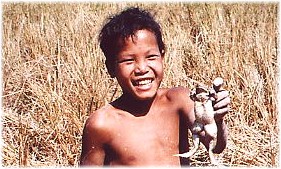
We left Prasat Bakan at 1pm, stopping to talk to a group of small children who had been frog-hunting, successfully, in the nearby rice fields. The surrounding countryside was beautiful as we sought Wat Rumlich, the supposed site of a Khmer Rouge victims memorial, which we found out had been dismantled a few years previously. Kousal fixed a back-tyre puncture at the side of the railway line before we headed back to Bakan and the burial site of a national Khmer hero, Oknha Khleang Moeang. Gaudily-painted statues, a burial mound and a resident police guard were all we found to mark the memory of this much venerated character. We stopped at the deserted train station - 0ne train passes through every day - and then visited the Province's director of fine arts and culture at his palatial office to ask for the key to the museum in Pursat, only to be told he didn't know where it was! Outside the padlocked museum, located next to my hotel, sat two lintels and an inscribed stele stone, but the contents of the museum remained a mystery. Kousal and I visited one of the many marble shops, an island in the center of the Pursat river and then went on a ride along the riverbank for a few kilometres to Wat Soriya, with its large buddha, wooden ceiling and very old wall paintings. Crossing the river via a wooden bridge, at Wat Preah Sdei we encountered monkeys and lots of caged animals, next to the modern vihara. I was back in my hotel for 5pm and arranged for Kousal to return at 7am the next day. Communication with him was stilted, but at least he was very willing to learn more about his town and its surrounds, so I persevered. I had a chicken supper at the nearby Raksmei Angkor Phnom Pich restaurant for $1.5, but it was noisy, so I finished the day with a tikalok at a stall along the river - a full moon and four attractive girls serving the drinks were a bonus - but it was next to an electricity station and it gave me a headache, so I called it a night and was in bed by 9.30pm.
My sleep pattern was still all over the place, I hadn't slept well since I arrived, so I was still tired when Kousal arrived at 7am and we headed east along Highway 5, stopping an hour later at Krakor for some noodles and coffee. Our destination for today was the Vietnamese floating village of Kompong Luong - located on the southern edge of the Tonle Sap Lake - and the sign oppositie the food stall indicated the village was 5kms due north. We arrived at the boat dock at 8.30am and I paid $5 for an hour's ride, just the pilot and me, visible to all with my flourescent orange life-jacket. The floating village is a substantial community of up to 10,000 people and the number of water-borne homes and shops was larger than I'd ever seen before. I spotted a church, school, dentist, two gas stations and lots of floating stores. We squeezed between the houses and past other boats - I was splashed by one boat and got completely soaked - so I got to see everything at close quarters and elicited lots of waves and hello's from the children and adults alike. We also went out into the open expanse of the lake, which was quite choppy as the wind picked up. It was a very enjoyable hour and I rejoined Kousal onshore just before 10am. Returning towards Pursat along Highway 5, we took a left turn on the hunt for Phnom Baykhlor, encountering some more children hunting for frogs in a field before arriving at the 100 steps leading up the hill to the pagoda, Wat Damrei. It was a tiny vihara with very old lion statues and seima stones and a group of friendly monks, but no ancient temple amongst the trees, which I'd hoped for. I had lunch with Kousal at the Phnom Pich restaurant back in Pursat at 12.30pm and took a shine to my smiling waitress, Srey Mom. I also purchased my coach ticket for Battambang the next day, with Capitol Tours.
Straight after lunch, we took another ride along the river, past the large Cham community, stopping at Wat Po Sovan Reangsey with its old wall paintings and then at Wat Kompong Krasang, at the end of a large suspension bridge spanning the river. We chatted to a couple of friendly monks, Vuth and Chon, who spoke good English and after I made them laugh by riding a rickety bicycle, they proudly showed me their wooden pagoda with its peeling wall paintings. Through the village of Kandieng, we called in at the Kumar Ney Kdey Sangkheum Center to watch the varied activities on offer to support youths from problem families in the area. With Japanese funding, teacher Sok Sambath showed us classes where the shy youngsters were making kramas, sarongs, bags and wooden furniture. The ride along both sides of the river was very pleasant, the people extremely friendly and its a definite must-do if you come to Pursat. I was back at the hotel by 5pm, thanked Kousal for his help and returned to the Phnom Pich for a barely-edible supper of fried chicken. Under a full moon I stopped for another tikalok fruit-shake but was back at the hotel by 8pm to watch football on the tv. I was nearly at the end of the Pursat leg of my trip - I found the town less than fascinating and when i return, I will use it as a launching pad for visits deeper into the countryside, and I may even be lucky enough to find the key to the museum! Link: Cambodia Tales.
UNESCO delay Preah Vihear listing
Whilst I'm on the subject, I'm currently reading a book called Climbing Back Up by Kim Chou Oeng, which contains his personal experiences during the Khmer Rouge years as well as a shocking description of a decision by the Thai authorities in 1979, to forcibly repatriate around 45,000 Cambodians. They were forced by Thai soldiers to climb down the steep slopes of the Dangrek mountainside at Preah Vihear through unmarked minefields as well as being shot at by both Thai and Khmer Rouge soldiers. Thousands died. This Associated Press article from 18 November 1999 recalls the period:
On a cliff in Cambodia old Preah Vihear temple has tragic recent past - by Grant Peck AP
Perched on a cliff top in northern Cambodia, Preah Vihear temple is a sacred 10th-century place dotted with profane reminders of the country's more recent tragic history. As tourists climb the 2,805 feet of crumbling stairs to the temple's four levels, they pass the wreckage of an army helicopter. At the summit, they share a spectacular view with two artillery pieces. The military hardware is left over from barely a year and a half ago, when the final 60 Khmer Rouge rebels occupying the location surrendered to government forces. Now, at a place where not that long ago the fate of uninvited visitors was death, tourists are coming again. Most of them - overwhelmingly Thai, many of them Buddhist monks - say they come to see the temple and the view, not the detritus of war. "When I see Preah Vihear and appreciate its beauty, my tiredness from climbing from bottom to top disappears," says Thanat Phukovareenukul, a Thai on his first visit. Cambodia was plunged into chaos and civil war after American bombings in 1970, and only in the past year or so has peace returned. An estimated 1.7 million people died. During the ensuing brief and brutal reign of the Khmer Rouge in the late 1970s, hundreds of thousands were killed in its attempt to create a peasant communist state.
Preah Vihear is a footnote to that terrible war, just as it is an archaeological footnote to the glory of the incomparable Angkor Wat temple complex that is Cambodia's proudest heritage.
It's even a footnote in international law - the object of a controversial 1962 ruling by the International Court of Justice that awarded it to Cambodia, even though topography suggested it should go to Thailand. The ruling accounts for the oddity of Preah Vihear being a Cambodian national landmark that is, for all practical purposes, accessible only from Thailand. The guerrillas who held the temple since 1993 rarely had to fire a shot in anger, because any attempt to dislodge them would have required a suicide attack up the steep, heavily mined Cambodian side.
But this little crag of Cambodia witnessed other horrors. The supposed remains of two Belgian tourists widely believed to have been abducted and killed by the Khmer Rouge guerrillas in 1994 have been turning up over the past year, some of their bones offered for sale by traders hoping to collect a bounty. Investigators believe that other foolhardy tourists were similarly waylaid.
The Khmer Rouge don't hold a monopoly on cruelty, however. In 1979, Thailand was being flooded by refugees from Cambodia who fled as the Vietnamese army drove the Khmer Rouge from power. On June 8, 1979, the Thai army gathered thousands of desperate Cambodians from all over eastern Thailand and trucked them to the border at Preah Vihear. They were forced to march down the steep slopes back to their country. "The path down the mountains became steeper, the jungle thicker," British journalist William Shawcross wrote in describing the scene in his book "The Quality of Mercy." "Dozens, scores of people fell onto mines. Those with possessions had to abandon them to carry their children down. One group of refugees desperately pooled whatever valuables they had left, filled two buckets with them, and walked back up toward the Thai soldiers, carrying a white flag. The soldiers took the buckets and then shot the refugees." About 45,000 refugees were compelled to make the risky trek down the slope, Shawcross estimates. There are no definitive figures on casualties, but they are thought to have numbered in the thousands.
Visitors today are not so interested in such recent history, says Kraipon Royto, a lieutenant in a Thai paratrooper unit stationed near the temple. In his uniform, he serves as a volunteer tour guide. "The most popular question from tourists is if this temple was built at the same time as Angkor Wat," he says. Many historians think it predates its famous cousin. Supachai, a visiting Buddhist monk, is impressed that people so long ago could make such a beautiful structure. "We should be proud of the ancient wisdom which was so creative and powerful," he says. A handful of Cambodian soldiers, with their wives, are bivouacked at the temple, shyly selling cans of soda to visitors and collecting empties to sell as scrap. About 200 of their countrymen live and work at a market at the foot of the temple. Eng Tangheng sells exotic knickknacks and traditional medicines. "Whoever pays his respects to this temple will be lucky and be able to sell things better than his competitors," he says.
Footnote: I've visited Preah Vihear on two occasions, the first in March 2002, when I climbed to the temple, not by a road, but by crawling up the side of the mountain, hanging onto tree branches for leverage and hoping my footing didn't give way. It was a tough climb but I didn't have the fear of landmines or of soldiers shooting at me like the Khmer refugees did in 1979. Read about my visits in 2002 and 2005. Two other websites that you might find interesting are here and here.
Thursday, June 28, 2007
Notes from Siem Reap : Part 2
Morning began with tearful goodbyes over breakfast to Kim, who was due to fly to Australia around midday. I, on the other hand, headed west along Highway 6 to enjoy a varied day of sightseeing with Rieng and Heng in their 4WD Pajero. Its a good road these days, busy and flat until you get to Sarsadam, where the tarmac ends and a very bumpy and dusty rode begins. Our first stop was in Prey Chrouk village – which is Rieng’s home village – where we visited the primary and secondary schools, side by side, to look in on the new school building (five classrooms) donated by a joint venture between ADB and the Sage Insights travel company in Siem Reap. With over 1,000 students at both schools, another brand new two-storey building, donated by Prime Minister Hun Sen no less, was locked and empty as there were not enough teachers to use the classrooms! I stood in front of two grade 9 classes, ages ranging from 16-20, to say hello and spotted Rieng’s younger brother, Ratha, in the second row. When Rieng lived in the village there was no secondary school, so he had to cycle to Sarsadam for his education.
Continuing on, just after 11am we reached the roundabout in Preah Net Preah village - 88kms from Siem Reap said Heng – and then headed west for three kilometres on the lookout for Phnom Arayacontra (or Prasat Preah Net Preah). It’s the biggest hill there so you can’t miss it. 200 steps later we were enjoying a wonderful view from the summit. Its an interesting site with old and new mingling together – old, in the form of broken colonettes and an unusually large pedestal, three undecorated lintels and a blue corrugated tin stupa housing two more pedestals and a small inscription on a doorpost. Alongside were the remains of two demolished brick towers with sandstone door frames. A friendly nun, Tre Chantha, told us the four resident monks and two nuns were off at a celebration and took us to a locked room to show us an inscribed boundary stone and some other sculpted pieces, as well as some carved figures on large sandstone boulders.
Retracing our route along Highway 6, we stopped briefly at the pagoda at Prasat Romduol village on the hunt for Prasat Tayrin, but were assured that the colonette we found was all that remained and the thigh-deep river that barred our path dissuaded us from checking ourselves. By 2pm we’d stopped at Kralanh for lunch – fried chicken and vegetables, chicken soup and dried fish plus drinks, all for $5, before we headed east towards Tek Chou. The village pagoda had some friendly children but nothing else of note, though Wat Char Leu was a different story, housing a laterite tower with red sandstone doors though minus its lintels, situated next to the old vihara. It was a site I’d visited before. Returning towards Siem Reap, we stopped at Prey Chrouk again to visit Rieng’s family home for an hour where I met his mum, dad, granddad, two sisters and two brothers and a souvenir photo for my album. Like Rieng, they are lovely people. Back at Siem Reap by 6pm, I joined up with Rachel Wildblood - a VSO fisheries worker I’d previously met in Kompong Thom – for dinner at the very popular Khmer Kitchen. I enjoyed an excellent chicken curry and a chat with the owner Sophal about her successful business which now employs forty staff. Back at the Shadow of Angkor guesthouse, we were joined for a drink by David Musa, an Israeli archaeologist-cum-tour leader, who I knew by email contact before my trip began.
More temple adventures were the order of the day as we set out next morning for Beng Mealea at 8.30am via the town of Damdek. The road toll for the 4WD was $5 and the temple pass another $5 as we arrived at a temple I’d first visited in 1999. In those days, it was a serious adventure and extremely hard work – nowadays the temple sees between 50-100 tourists each day and wooden walkways make exploration very straightforward. Not one to follow the crowd, Rieng and myself investigated the rarely-visited east gopura and its impressive array of naga heads and lanterns leading along the 400 metre long causeway, accompanied by beautiful bird song all around us. At the eastern entrance large stones blocked our way in so we had to climb up and over the massive gateway, perching precariously on top of the gopura before heading for the north library and taking an anti-clockwise route around and through the whole temple. Beng Mealea is an extraordinary size and deserves its new found popularity. There’s so much more to see than on my previous visits, though the prize you have to sacrifice is the real adventurous feeling I used to experience. During our exploration I met Shinto Asano, an English-speaking Japanese girl who was gushing in her praise for the temple. At midday, with Rieng translating, I renewed acquaintances with Chheng Chhun, the temple guide who showed me around in 1999 and at 72, he’s still very sprightly for his age. He told me he was born in the area and is proud to show people his temple. As an added bonus, he told us about a trio of smaller temples lying east of Beng Mealea along the ancient Royal Road and agreed to be our guide for our afternoon exploits. I’d been on the Royal Road before, around the village of Khvao, so this was an opportunity to see another part of the highway.
At 12.30pm, with Chhun in charge of directions, we joined the old royal highway that linked Angkor with the former capital of Jayavarman VII at Preah Khan at Kompong Svay, and the laterite base is still in use today, albeit with a sandy covering. We passed through an area under the control of CMAC de-mining teams, and onto the substantial village of Chantrea, and the waves and smiles of villagers not used to visitors. The sandy surface made driving tricky - though Heng is a magician when it comes to negotiating difficult tracks - past the so-called Japanese stream, one of three riverbeds we crossed, and lots of tree-felling before arriving at our first ancient laterite bridge, Spean Khmeng, complete with ruined sandstone balustrade. Ten minutes later we hit upon Spean Teap Chei – another laterite arched structure – and at 1.15pm arrived at our farthest target, Prasat Teap Chei, or more precisely the village of the same name, some 15 kilometres from our starting point. With Chhun leading the way, we ploughed through very thick undergrowth without much success for twenty-five minutes and almost gave up until we encountered a large laterite wall and the eastern gateway to the temple. With one central sandstone tower with a porch and four doors, two smaller libraries and one solitary eroded lintel, it was cloaked in the forest and impossible to photograph, not to mention the humidity and stinging sweat in my eyes. As for Chhun, he didn’t even break sweat. Back on the Royal Road, we turned for home, stopping at two more temples we’d bypassed earlier. Prasat Kongpluk has a central laterite pyramid tower, somewhat ruined, with four sandstone entrance gates in a surrounding laterite wall. Scattered amongst the debris were colonettes, a worn lintel, two broken lions and lots of red de-mining tape warning us to avoid certain areas. Closeby, another temple, Prasat Chrey, had already been de-mined. It’s a good size, a sandstone and laterite mix with a lantern causeway leading to one central tower opening to the east with a sandstone porch, two libraries and three gates in the laterite enclosing wall. It was a nice setting and a good temple, just five minutes from Beng Mealea, to end our expedition.
In a small café opposite the entrance to Beng Mealea, we stopped for noodles, rice and chicken and thanked Chhun, who pedalled off into the distance with a big grin. At 4pm, we took the road that leads to Banteay Srei on the hunt for our final temple site of the day. Turning south at the temporary home of a de-mining unit, the track was getting a bit tricky and the area remote and another forty-five minutes into our ride, the bumper fell off the 4WD. Rather than risk further damage, Rieng and I walked on and used two young men to guide us to Prasat Banteay Ampil. Another fifteen minute walk, along a flooded path and across rice fields near the village of Andong Pei, we arrived at the temple. And what an excellent find it was. Amongst the trees and sounds of cicadas, and with the 5pm golden light shining on it, the temple looked at its best. Inside a large laterite wall with sandstone gopuras, are two libraries and one substantial central tower with a porch, open to the east and west and housing some attractive carvings and lintels. It was tricky as the path through the temple is by picking your way around the rubble underfoot but its definitely a temple worth more time than we could allow. With the light fading fast we headed back to Heng and the 4WD, leaving us no time for a look at another ruin nearby, Prasat Lich. Prasat Banteay Ampil is about 8 kms from the main road to Damdek, but local help is essential to locate it. By 7pm, I was back at the Shadow for a long, hot shower and then out to Rieng’s home for a gorgeous home-cooked supper with Rieng, Sovann, her parents and three sisters, and lots of chatting and practising English with Phyrun, Kadka and Dary. At 11pm I climbed into bed for a well-earned sleep.
For my last full day in Siem Reap, I opted for an easier day, especially as the next leg of my trip with Sokhom would be the usual endurance test. A late breakfast, I had an hour at the internet café and then joined Phyrun, Rieng’s sister in law, at her vegetable pitch in the heart of the old market, much to the amusement of her fellow vendors and customers alike. An hour later, I met with another good friend of mine, Heang, for lunch at the Khmer Kitchen and continued my chat with Sophal, the owner, who took over the restaurant seven years before after being a cook for Medicins Sans Frontieres. As Phyrun had moved her pitch to a new location in the market, I repeated my retail apprenticeship in vegetable-selling, without much success but great fun nonetheless. I’d arranged for a 6.30pm meal with Socheata, Now and Plon at the Shadow restaurant but they were an hour late coming from their Angkor homes, so we had less time to chat and eat our amok, chicken curry and spaghetti before the 9pm arrival of some more friends. I said my goodbyes to Socheata and welcomed Rieng, Heang and Phalla – three great friends of mine – to celebrate my last night with some drinks and friendly banter at a couple of Khmer restaurant-bars, until midnight. We recalled lots of great memories from previous trips together and it was a suitable way to end my stay in Siem Reap.
Link: Cambodia Tales.
Musical titbits
Here's a quick round-up of musical matters for bands I'm keen on:
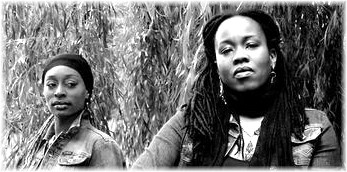
The debut performance of Rainy Days and Mondays will take place tomorrow (Friday 29 June) at The Java Lounge Coffee House on St Edward St in Moseley, Birmingham, starting at 7pm. If you can get along, all friendly faces are welcome. RD&M's are Leonie Moore and Indigo, a duo who'll sing a mix of covers and their own tunes with a folky-chillout vibe, and who already perform togther as part of the reggae group Gabbidon. Both girls are excellent vocalists with a strong and versatile range - so its definitely worth making the effort to see their new venture.
Talking of Gabbidon, fresh from their storming performance at the Glastonbury Festival last weekend, their next gig is at the Hereford Arms in Hereford on 14 July. They then appear at the Glade Festival in Lye on the 20th and follow that up at the The Cross in Moseley on the 28th.
My favourite reggae band of all-time, Steel Pulse, have just concluded an American and Caribbean tour and have a few days rest before embarking on a series of gigs in France and Holland before returning back to the States for more dates. Sunday 19 July, they're scheduled to join in the WOMAD festivities in Wiltshire. The Electric Strawbs line-up are currently rocking them in the States and make their next UK appearance in Putney on 7 August.
Hot off the press.... Jimi Lundy, the Cambodian-born singer, now living in Australia, is currently working on his second album, after the success of his first release, Steal My Heart. He has a single due for release on 1 September, called When We Were Young and the EP will include a track in the Khmer language - When Tomorrow Comes - and will also host his excellent tune Cambodia, as a bonus track specifically remastered for the single release. The Cambodia track will also be featured in the forthcoming film release, The Red Sense. There are also plans afoot for Jimi to play a concert in Cambodia in December.
Wednesday, June 27, 2007
Notes from Siem Reap : Part 1
Amidst the mele, I spotted Rieng and his moto and his ever-present wide grin. His big hug said it all – it was great to be back in Siem Reap with my best friend and top guide. I’d forewarned him I was on my way, and his three hour wait hadn’t suppressed his usual enthusiasm, as we caught up with each other on the ride into town and straight to my home-from-home, the Shadow of Angkor guesthouse. Expecting another big welcome, it didn’t happen as the guesthouse owners, Seng Hour and Davy and their daughter Kim were in Phnom Penh, but it was good to be in familiar surroundings and I had a fruit-shake with Rieng and his wife Sovann, who arrived to join us, in the guesthouse’s excellent restaurant. After a shower, I walked along the busy pub street, flush with tourists of every nationality, and headed for a fish and chip supper at Molly Malone’s. I returned early to the guesthouse to catch up with Kim and her parents, and that postponed welcome, as well as meeting Juanita and Matthew, who I knew from email correspondence before I left home. I was all talked-out by 12.30am and retired to my comfortable room and slept soundly until 8am the next morning.
For my first full day in Siem Reap, I was on a mission. Rieng had told me a friend of mine who I’d not seen for six years was back living in her village inside the Angkor complex, so that’s where we were headed at 10am, after breakfast with Juanita and Kim. It was a very hot day already as I paid $20 for a 1-day temple pass and took the road to the temple of Banteay Kdei, entering through the east gate, opposite the Srah Srang lake. And there she was, at her stall selling souvenirs and beaming that huge grin as if she’d never been away. I first met Socheata in 1999, as she was the elder sister of Noung, another souvenir-seller I had met at Angkor Wat a year earlier. But Socheata had disappeared overnight six years ago when I was told she got married and moved to live in Japan – I thought I would never see her again – until today. Now 28, she returned five months ago after her husband had died prematurely. I was pleased to hear that their marriage had been a happy one and they’d spent a lot of their time together travelling the world, including a visit to Europe.
It was an emotional reunion, both for Socheata and myself, as well as Rieng who knew her well, and we were also joined by her brother Plon and her mother, as we chatted as old friends do, for a couple of hours. With a promise to meet at Angkor Wat a little later, Rieng and myself headed off, ignoring the no-entry signs to pay a visit the secluded temple of Ta Nei, one of my favourite minor temples, where I can almost guarantee to be alone amongst the ruins and the sounds of the surrounding forest. We had lunch with another friend, Shanti, at her food stall (no.9) at the west gate of Ta Prohm before rushing over to Angkor Wat and entering via the quieter eastern entrance and walking around the perimeter to the cluster of souvenir stalls situated alongside the pagoda on the northern side of the temple. There I spent the next three hours talking non-stop to Socheata, her sister Noung, her six month old baby and her husband, Mean Somnang and her best friend Now. The souvenir sellers are a close-knit bunch of people, many live in the same village next to Srah Srang and lots of them recognised me from many previous visits. I didn’t even manage to set foot inside Angkor Wat itself.
I returned to the Shadow and had a drink with Juanita and Matthew before a 7.30pm appointment with Dougald O’Reilly for dinner at the Soup Dragon restaurant. Dougald is the Director of the NGO HeritageWatch, which is busting a gut to stop the illegal trade in Cambodia’s cultural heritage and to protect and preserve it by way of educating the local populace and raising awareness by various initiatives including their new magazine, Touchstone, and Dougald is the brains behind it all. He was great company and the Vietnamese food we tucked into was excellent. Back at the Shadow I caught up with Seng Hour and her daughter, as we talked in detail about Kim’s impending departure in just three day’s time, to spend the next four years at university in Sydney, Australia. The following day, Heng drove Rieng and myself to the floating village of Kompong Khleang – which you can read about in a separate travelogue. It’s one of a handful of villages fairly easily accessible from Siem Reap and is a worthwhile alternative for anyone who’s keen on a break from temple visiting.
The morning of day three in Siem Reap was to be spent visiting school, more precisely schools receiving support from a UK charity, Schools for Children of Cambodia, who provide free schooling for kids aged 4-12 in and around Siem Reap. Rachel Palmer, SCC’s in-country organiser and her right-hand man Jay, arrived at the Shadow just as I finished breakfast at 8am. Accompanied by Rieng and Heng, we drove out to Khnar primary school, just three kilometres outside of town in the direction of Roluos and one of the six schools receiving SCC’s support. Five new classrooms costing $6K per room and had just been built thanks to sponsors like Andy Hill and will increase the school’s capacity to teach up to 800 children. Also onsite were brand new water filters that provide clean water for the school and I also spotted two sandstone pedestals under a tree, next to the garden which the kids were watering and weeding. At 10am we were back in town and heading for Wat Athvea, a laterite temple next to a pagoda, a couple of kilometres down the road leading to the Tonle Sap lake. Next to the ruined west gate of the ancient prasat is another SCC school, Krosang Roleng, with space for 230 children and class sizes of up to fifty per sitting. It was another well-presented primary school and a grateful head teacher, who praised the charity for their efforts at his school. Our final visit was to Sway Dongkum school, where volunteers Pete and Kat were teaching some of the school’s 500 children English for an hour from 11am, as part of SCC’s volunteer program. I thanked Rachel and Jay for showing us the work of SCC who are doing a fabulous job in providing education for free for so many children.
Back at the Shadow, I had lunch with the owner Davy and helped Kim with her leaving speech, which she would deliver at her ‘going-away’ party later that same night. In the meantime, Rieng collected me at 2.30pm for a visit to one of my favourite places to relax, the Angkor Conservation Office, where most of Angkor’s free-standing statuary is held for safe-keeping, some in the Conservation garden and the superior quality pieces, under lock and key in two large storage buildings. We chatted to Kleng Reach, who’d I’d met on previous visits and for a small tip, he took us into one of the large rooms where over 200 original sandstone heads of gods and demons from the Angkor Thom and Preah Khan gateways were arranged in rows on the floor. Also in the room are inscription stele stones, pedestals, linga and lintels of outstanding quality and undoubtedly of museum standard, whilst outside the door, line-up along a wall, is the bounty retrieved from the home of the former Khmer Rouge leader Ta Mok including apsaras, nagas, lintels and lions, especially a stunning example from Wat Lovea. Another two-storey storage room nearby was off limits according to Reach and we had to be content with peering through the broken glass window at the sculptures earmarked for the new Siem Reap museum, when it opens in the middle of the year. On our way back we popped into the Jasmin Lodge guesthouse to say hello to the owner Khun, a former guiding colleague of Rieng’s and then it was back to the Shadow and Kim’s farewell party, organised by her parents. It began at 6.30pm and turned into a great send-off for the 17-year old, who in turn was excited and emotional by the turn-out as up to eighty of her friends and family ate and drank their fill and danced through til 12.30am. And the speech – there wasn’t a dry eye in the house.
Tuesday, June 26, 2007
Notes from Phnom Penh
Here's today's 2007 Cambodia Tales travelogue piece - just one more to go.
Notes from Phnom Penh
OK, here goes…Cambodia Trip No. 13. My midday Thai International flight from Heathrow was delayed by an hour as we sat on the runway though we still arrived on time at Bangkok’s new Suvarnabhumi airport at 6am. My transfer time was under two hours as I caught the 7.50am flight to Phnom Penh, arriving at Pochentong on time at 9am. For the majority of my time in Phnom Penh, at the start and end of my four weeks in Cambodia, I spent it either whizzing around meeting friends and contacts or putting my feet up and resting. Passing through arrivals unscathed, I was met at the airport by Rith, aka Hing Channarith, the CEO of CCAF, an NGO helping kids in Kampot, who gave me a lift to my usual hotel in the city, the Dara Reang Sey, and discussed the work of his NGO over cold drinks. As ever, the welcome from the sisters who run the hotel was effervescent and they gave me their mobile phone to use for the next month. After a shower, I collared young Thearith on the reception desk to double-up as my motodop, and at 2.30pm we took off to visit Vansy and her family in Kien Svay. Another heartfelt welcome awaited me, and mum rushed off to fetch Vansy and her friend Sary from school. Vansy’s English is getting better all the time and after exchanging gifts, I attended her 5pm English class at the nearby school. Unfortunately, her teacher, Navin, was in hospital – she even called me to explain and apologised for her absence – so I improvised and took the class instead alongwith Sokhan, the substitute teacher. It was a delight to see Vansy amongst her peers and it was obvious she was more confident and fluent than everyone in the room.
I was back at the hotel at 7pm, ready for a visit to Sovanna Phum on Street 360 with another friend, Sophoin. The open-air performance was packed out with an audience mix of Khmers and foreigners for an hour of pure theatre with a show titled ‘Sokacha’ – an adaptation of the Reamker story with shadow puppets, classical dance, slapstick comedy and acrobats, all wearing traditional costumes and an orchestra – followed by a Q&A session and a quick chat with Delphine Kassem, the founder of the arts troupe. Shows are held every Friday and Saturday, there’s a $5 entrance fee and it was a really enjoyable experience for the hundred or so spectators; we followed it with drinks at the Boddhi Tree and the Rising Sun, where I caught up with Samnang, and a tikalok at Psar Chas to bring to a close my first day in Phnom Penh.
Day two began with breakfast at the hotel and a visit from two of my long-time friends from Tuol Kauk, Ara and Lina, who both gleefully announced they are getting married in 2008, and who both work for the NGO, World Vision. At 11am I walked to the riverfront and met with Vannak, one of my regular motodops, and checked my emails at an internet café. After lunch, I took Vannak’s tuk-tuk to Kien Svay to collect Vansy and headed for her auntie’s house, where I’d been invited to stay overnight. I spent the rest of the afternoon and evening practising English with Vansy, who’s now 14, reading from some books I’d brought from home. I was very impressed with her thirst for learning and with her aim to become a teacher or tour guide in the future. Her younger siblings, Matey and Vibol were also there and we all ate our dinner inside the summer gazebo in the garden, despite the red ants that feasted on my ankle!
By 10.30am next morning, I was back in Phnom Penh, visiting John Weeks and Geoff Pyle at their SangSalapak offices on Street 184 to find out more about their work. Both have provided articles for my forthcoming book, To Cambodia With Love, so it was a thank you visit and to find out more about their work with comics and architectural tours respectively. At noon, I went to lunch with Sotha and Keang at the ChitChat restaurant on Sihanouk Boulevard, with Rattana also joining us. All three are well-educated twenty-somethings, with responsible attitudes and who’d recently done a stint of volunteer work - they were great company. Next on my list was Glyn Vaughan and his All Ears NGO on Street 240, though with Glyn out, I had a tour of the offices with audiologist Sin Chan Seyha and gained a better understanding of the great work they do with hearing impairment and deafness. Glyn, another contributor to my book, returned and we had a good chinwag before I returned to the Dara for a shower in time for my 5pm meet with Loung Ung at the Foreign Correspondents Club on the riverfront. I’d met Loung once before, six years earlier, and we’d kept in touch by email so it was great to meet up again, and true to form, she was delightful company. The next four hours passed in the blink of an eye as we talked about everything and anything over a delicious Vietnamese meal at An Nam. Loung is a gifted writer and lecturer and was in Cambodia visiting family and writing an outline for a new novel. We said our goodbyes at 9pm and I popped into an internet café before returning to the Dara.
In the morning over breakfast, the Dara sisters gave me the coach ticket for my next day trip to Battambang and I took a moto to meet Tom Clements, a technical advisor with the Wildlife Conservation Society at the Java Café to discuss some potential temple targets in Preah Vihear province, an area which he’d visited as part of his conservation role. At noon, I had lunch with Sophoin at the Boat Noodles restaurant on Street 249, enjoying plates of delicious Khmer food before meeting another motodop pal of mine, Tom, who like Vannak, has swapped his moto for a more tourist-friendly tuk-tuk. Tom gave me a lift to the Russian Market (Tuol Tompong) where I searched successfully amongst the book stalls for some old military maps of northern Cambodia, followed by a quick stop to see Glyn at All Ears. Back at the Dara, another old friend, Sopheap, was waiting to meet me. Sopheap is still at the Sports Ministry and proudly told me he’s building a house in the Stung Meanchey district of the city, which I will visit on my next trip. However, we couldn’t chat for long as I was picked up at 6.30pm by Sam, in preparation for my ritual Phnom Penh meal with a group of friends, who all live in the Tuol Kauk district. More than a dozen friends and I sat around a circular table in the main room of Vourch and Sarein’s home and tucked into a gorgeous meal – with my favourite chicken curry, the piece de resistance – and a long chat and drinks before I returned to the Dara at 10pm, and an early night, ready for my 8am coach trip to Battambang the next day. The first part of my Phnom Penh story was over as I headed for my adventures in the northern part of the country.
Part two in Phnom Penh was considerably more restful, after enjoying trips to Battambang, Siem Reap and Preah Vihear province and more besides. The Mekong Express coach dropped me off at Wat Phnom at 2pm and I had a quick shower at the Dara before I got a lift back out to Kien Svay to stop for three nights at the home of Vansy’s aunt. Awaiting my arrival was Vansy, her siblings and a group of children and friends as we all sat down to a big group dinner and our first session of karaoke but without the music, when everyone took a turn in singing their favourite song. This became a regular after-dinner event for the next two days. My contribution was Jimi Lundy’s song Cambodia, which they all appeared to love and requested time and time again. During the day, I spent time playing badminton or football with the children though mostly it was 1-to-1 with Vansy, reading through books in an informal intensive crash-course in English! I was conferred with the title of Vansy’s ‘god-father’ and it was going well until I developed stomach cramps late on day three and suffered a serious bout of vomiting and diarrhoea. Vansy and her aunt’s home-spun remedy was to rub ceramic spoons on my lower back, much akin to ‘coining’, which is believed to circulate the blood and draw the ‘badness’ out of the body. I can’t testify that it works, but I can say it was the most painful experience I’ve ever had in Cambodia - believe me, it was excruciating.
Now back in Phnom Penh, I had lunch at the Rising Sun with Sophoin and then met Steve Goodman, a photographer, at the Dara for a drink. We walked to the Popil gallery to see their exhibitions and met Stephane Janin the owner and Jerry Redfearn, another photographer, who had an exhibition starting in a few days’ time. At 4pm I met up for a chat with Derek Phatry Pan at the FCC; he writes for the Phnom Penh Post and is a fountain of knowledge, before a quick return to the Dara for a shower and then a 6pm meet at the Kandal House restaurant on the riverfront. This was in fact a surprise meeting with another of my former guides, Soum Sophal, arranged by his Australian wife Kathy, who works for the NGO, HeritageWatch. I pretended to arrive quite by chance and caught Sophal completely unawares. I’d not seen him since 2003 and we had a great reunion meal alongwith Kathy and their son Luke. Sophal has now put his dirt-bike away and instead is running a successful gardening and decorating business called BizyBeez. We promised to keep in touch and we will. Continuing my theme of meeting as many people as possible, at 8.30pm Karen Coates and her husband, Jerry Redfearn arrived for a two-hour chat. Karen is the author of the excellent book Cambodia Now and Jerry is the photographer I’d met a few hours earlier at the Popil. It was great to meet them both especially Karen, who will also contribute to my guidebook. By 10.30pm I was completely exhausted and retired to my bed at the Dara.
I spent my last day in Phnom Penh keeping myself pretty much to myself, I was still queasy from the bout of sickness I’d suffered and took it easy, chatting to people at the hotel and walked to the riverfront to watch the world go by, chat to Vannak and use the internet café. I rang round everyone to say my goodbyes, received some gifts from the Dara sisters and others and reflected on yet another successful visit to Cambodia. The next morning I was at the airport by 9am, an hour before departure and met Heng Sophea, on her way to a conference in Hong Kong. We had a coffee during transit in Bangkok before I took the final leg of my journey home, watching the Steve Coogan film, The Alibi between bouts of sleep. Back on home soil at 7.30pm, the freezing cold temperature was far removed from hot and humid Cambodia, as trip number thirteen came to an end. Link: Cambodia Tales.
Reggaerockz Glastonbury
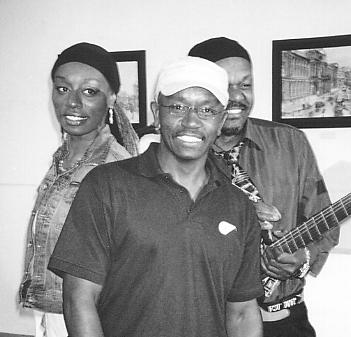
LtoR: Leonie Moore, Colin and Basil Gabbidon - one third of Reggaerockz/Gabbidon.Monday, June 25, 2007
Kong Nay and The Flute Player UK Tour - press release
Sick of slick, soulless muzak numbing you from every direction? Well, get ready for something rugged, real and bizarrely exotic hitting the UK music scene this July. Every one seems to know about Cambodia’s gruesome tragedies, and nothing about its ancient arts. But now an old blind man from the Cambodian slums called Kong Nay is making music visionaries like Peter Gabriel turn their heads: could this be the next Nusrat Fateh Ali Khan? Kong Nay’s Chapei music - the “Cambodian blues” - is about to strum and holler its gutsy way into your orbit. It’ll probably make you laugh (even if you don’t speak a word of Khmer) - it could make you cry - and you won’t have heard anything like this ancient, haunting yet foot-tappingly funky music before. Chapei doesn’t often wander so far from the rice fields of the Cambodian heartland or the slums of Phnom Penh, where rats dance lazily and dark-skinned children defy appalling poverty with beaming smiles. Yet, like Ali Khan’s music, it has a knack of speaking to people – bypassing cultures and languages.
Chapei music is special. You won’t find anything like it in neighbouring Thailand, Vietnam or Laos. Some say it’s like the Delta Blues. The lone impassioned Chapei singer belting out hard-hitting riffs and sliding blues-notes on his Chapei Dong Veng (“long-necked, two-stringed guitar”) is surely like the rugged Delta bluesman with his weeping slide guitar, roaming the poverty stricken Mississipi. And the heart of both is roguish, by-the-seat-of-your-pants improvisation. But Chapei is a more primordial blues - heard long before even the great Cambodian kingdom of Angkor. Legend has it that Chapei’s lamenting, laughing path winds back 25 centuries, when Buddha himself introduced it to the world as a symbol of the “middle path”. If Chapei is the “Cambodian blues” then let the “Cambodian Ray Charles” bring it to us this summer. Blind Chapei master Kong Nay not only seems to look and feel like Charles, with his trade mark gangster sunglasses and a smile that has been known to out-shine even the dazzling Cambodian sun. He is also a soulful genius, able to move people through the whole range of human emotions with his husky old voice – from raucous slapstick to Buddhist mysticism. He can recite an ancient religious epic word for word, or improvise a tall yarn on the spot. Part sage-part clown, Nay often has his audience dancing in the aisles overcome with laughter, or openly weeping at the sadness of his poetry. One of the two greatest living Chapei performers, 62-year-old Nay is a legend in his homeland. He is Cambodia’s most recognizable traditional musician, and is adored for his humanity as much as for his music.
“As a singer I’m very drawn to voices, and it was his voice that pulled me right in at the beginning,” says rock legend and international humanitarian Peter Gabriel about hearing Nay for the first time in the movie “The Flute Player”. “There’s a warmth that comes out, and you know there’s been some suffering there. You feel both the sun and the rain coming out of that voice.” Gabriel grew up on the Blues and although he had never met Nay, something resonated in him: “I’ve got absolutely no idea what he’s singing about. But it’s the gutsiness, simplicity, and heart-felt quality - along with the acoustic instrument and improvising.” Gabriel was hooked and last year he sent recording engineer Dickie Chappell to Cambodia to record Nay for an international solo release for Real World. Chappell was bowled over by both Nay’s music and humanity – and also saddened by the poverty that Nay lived in. He felt he had to do something for this man, and so he organised the UK tour off his own back.
Sad stories are never far from the people of Cambodia – recent home to the Killing Fields of Pol Pot’s Khmer Rouge: Kong Nay, blinded by small pox at four, was seen as dangerous by the Khmer Rouge, who systematically murdered or forced into exile around 90 percent of Cambodia’s artists and intellectuals. Chapei singers, famed for their satirical political comment, were doubly dangerous. In 1979 the Khmer Rouge marched Nay, his wife, and five of their eventual 11 children into the killing fields to be murdered. Miraculously they were rescued - literally at the last minute - by Vietnamese soldiers fighting the Khmer Rouge. The Khmer Rouge are no more, but is Pol Pot’s dream of eradicating Cambodian arts still a reality? Resourceless, uncaring and corrupt government officials do almost nothing to support their unique but highly endangered artistic heritage - preferring to work on their private bank accounts instead. In the early nineties many top traditional Cambodian musicians, dancers and artists were given land by the Ministry of Culture in the Dey Krahorm slum in central Phnom Penh – including Nay and his family. This was near the Royal Palace, University of Fine Arts and cultural centre of the city. Over the years the slum became one of Cambodia’s most cultured communities, even if still poor.
However corrupt government officials are now selling off inner city land to foreign investors, pocketing the money for themselves and then forcibly evicting the residents – often with violence - to squalid settlements miles away from the city with its hospitals, schools and other amenities. Dey Krahorm is one of the last remaining pockets of “slum” in the inner city river area, and is gradually being evicted. Around Nay’s little house are properties now evicted and covered in razor wire to prevent people reestablishing. Even as Nay gains in fame and stature, his rights seem to be disappearing - any day now Nay is expecting to be evicted. “They say they’re going to send us 32kms away,” said Nay. “It’s too far away, especially coming back from performances at night time.” Everyone in this close-knit community is worried about arson, which has often been an unofficial method of clearing valuable land of squatters in Cambodia. This is frightening for a blind man. After recording Nay, Chappell visited him in his shack in Dey Krahorm and was shocked at the war-zone atmosphere and the government’s systematic clearance of this treasured community. “If these evictions were going on in England, there’d be riots and people setting fire to parliament,” says Chappell, amazed at how the Cambodian government seems to give no value to its cultural heroes.
Enter the knights in shining armour: foreign NGOs like Cambodian Living Arts (CLA). CLA gives Master Nay and 16 other masters of endangered Cambodian arts a small salary to make ends meet, and promotes and organises their performances. Cambodian performance fees are meager, even for legendary artists like Nay. The CLA masters in turn all teach promising young students in an effort to save their arts from extinction. CLA was the brainchild of Arn Chorn-Pond, who was nine when Pol Pot took over Cambodia. “My whole family were slaughtered because they were all musicians,” Arn says. “I started playing khlouay [Khmer flute] in the KR - they said ‘Play or die’. They killed off the old masters and brainwashed the kids to play revolutionary songs.” The KR murdered Arn’s first flute teacher before his eyes after he had taught Arn for five days. But when the KR tried to make Arn personally kill his second teacher, master musician Yeoun Mek, he courageously outwitted them. Arn saved Mek’s life, and nearly lost his own as a result. Arn’s life was spared because the Vietnamese invaded – the boy was sent off to fight at the front line. After living as a refugee in the US Arn returned to Cambodia years later. He managed to find Mek – an alcoholic wandering the city streets with no work. Mek became one of the first masters in Arn’s CLA.
Nay’s UK performances will be preceded by “The Flute Player”, a deeply moving one-hour film about Arn’s battle to save Cambodia’s traditional music from extinction. The documentary was nominated for an Emmy and features Cambodian master musicians, including the charming and unassuming Nay. It also offers a poignant glimpse into the contradictory world of modern Cambodia – full of wrenching tragedy and childlike laughter, just like Nay’s Chapei music. Of course it was Arn who sent Gabriel a copy of “The Flute Player”, introducing him to Nay’s Chapei in the first place, which is where this whole story begins… UK audiences will be able to check out Chapei’s new blood, as Nay is also bringing his most talented female protégé, 21-year-old Ouch Savy. Although a male-dominated art-form these days, there has a been a strong female Chapei tradition. Members of the King’s harem included competent Chapei players. Woman singers these days tend to be more lyrical and lilting, shying away from the rapping, sliding blues notes and general monkeying about of the men. However Savy may have to do her share of dueling and sparring if Master Nay calls her up to duet with him – an important and exciting part of the Chapei tradition, which calls for much rapping, rhyming and a lightening wit. Savy is an exceptionally talented young musician, who has made over 20 television appearances and performed with Khmer-American band Dengue Fever. Even more amazing is that Savy is also a leading singer in two other very different Cambodian traditional genres: Ayai and Mohori. Nay and Savy are playing 14 concerts throughout the UK, starting on 19 July in Norwich and finishing 6 August in Oxford. The highlight is two appearances at the Charlton Park WOMAD festival in Wiltshire. As well as Nay’s solo CD due out with Real World, he will be broadcasting on BBC’s Radio 4.
Link: Cambodianlivingarts.
Kompong Khleang
Here's today's 2007 Cambodia Tales instalment. Enjoy...
Kompong Khleang
The floating villages of the Tonle Sap Lake are an enticing alternative attraction for visitors and each of them has its own unique characteristics. 99% of tourists who visit a floating village go to Chong Khneas at the northeast corner of the lake – its just a stone’s throw from Siem Reap and is a real floating village, moving its location depending on the water level - but it gets a lot of negative press because of the mafia who run its tour boats, its drinkshops with tame snakes, pelicans and monkeys, and its plethora of Korean tour groups. Further south from Siem Reap are two more floating villages that are fairly easily accessible, namely Kompong Phluk and Kompong Khleang. I visited Kompong Phluk in 2005, so this time I headed for Kompong Khleang. But don’t think that’s it as far as large settlements on the banks of the lake are concerned – I’ve already paid a visit to Kompong Luong in the south and passed through Prek Toal in the north; and future visits to other villages like Moat Khla are on my must-see list. In all, there are 170 floating villages on the lake itself.
Our visit to Kompong Khleang – 51 kms from Siem Reap – began at 8am with the arrival of Rieng and Heng at my guesthouse in their Pajero 4WD. I’d already been up for an hour, showered and enjoyed a chat over breakfast with new friends Juanita and Matthew. Taking Highway 6 through Roluos, it took us half an hour to reach Damdek. Heng told me it was 37 kms to our turn-off point to Kompong Khleang, opposite a small group of stalls a kilometre after the central market in Damdek. The road was sealed for another couple of kilometres then became less so as we took another twenty-five minutes of careful driving to reach the village. As it was the dry season, we were able to drive into the centre of the settlement, but at the height of the wet season, when the Tonle Sap expands to five times its normal size, its more likely you’ll need to enter by boat, as you do with Kompong Phluk. Rieng and I got out to walk along the ‘high street’ as we entered the village – something of a misnomer as upwards of 30,000 people live there – as Heng drove to the market area to wait for us. Tourists are still something of a novelty in Kompong Khleang, so my presence elicited lots of hello’s and waves from the adults and squeals of delight from the children. We stopped at regular intervals to chat to groups of women, of all ages, gutting the day’s catch of freshwater fish or setting out trays of tiny fish or shrimp to dry in the overhead sun. Behind the houses to my left – all of which were on high wooden poles or stilts up to ten metres off the ground – was the river channel that led to the lake but for now the street was dry and dusty, though would look considerably different in six month’s time.
We reached the market area at the centre of the village which is on a small hillock, enabling the market itself, the health centre, the primary school and the pagoda to remain on dry land all year round. A wedding reception was in full flow – it was the wedding season in Cambodia afterall – as we walked around the market and called into the pagoda, which has colourful paintings on its outside walls and a weather-worn lintel, with Indra atop Airavata, by its front steps, the only relic from a long-disappeared Angkorean temple on the site. The school children were on exercise duty which consisted of running around the main school building ten times, so there were blue and white uniforms everywhere and a cloud of dust. Behind me I heard someone calling my name and turned around to find Rachel Wildblood – a VSO expert working with the fisheries office, who I’d met last year in Kompong Thom – in the middle of a meeting with the commune’s fishing hierarchy. As you can imagine, fishing is the lifeblood of the whole community – I was told there are more than 200 species of fish found in the lake - so we agreed to meet later in the week, and I beat a hasty retreat to a drinks stall in the market, where Heng was in deep conversation about daily life in the village.
The area that the settlement covers is enormous, it’s the largest community on the Tonle Sap and extends out onto the lake where there is a permanent group of floating houses. Next to the market is a pontoon bridge with a removable central section to allow boats to pass, that straddles the main river channel and leads onto a lot more houses and the secondary school. As we retraced our route back down the high street, we were invited to lunch by a group of women, who asked lots of questions and who made me blush with their compliments, and who also invited us to return in three days for a big ceremony in the village, which I had to decline. Our two-hour visit to Kompong Khleang had been an enjoyable one – I was the only tourist in sight – and it would be easy to spend at least the next few days getting to see more of village life but I had a full schedule, so we said our goodbyes to our new friends and headed back to Siem Reap. A couple of kilometres along the road back towards Highway 6, we stopped as a large crowd had gathered after a moto had struck a young girl, who was lying motionless at the roadside but our offer of help was waved away. I also spied a broken lintel in a spirit house next to a small bridge, where the taxi boats congregate in the wet season.
I was back at the Shadow of Angkor guesthouse by 1pm for lunch with Kim in their excellent restaurant that looks out onto the Siem Reap river, just a block away from the bustling old market area. Kim is such a bright spark and an amusing lunch companion with her corny jokes, as we discussed her impending move to study at an Australian university. We also went for a browse around the aisles and stalls at the old market before I took a moto to the office of Sage Insights, close to the Hotel De La Paix. Sage is the brainchild of a pal of mine, Andy Booth and his Khmer partner, Phalla Chan and is a travel company with a purpose, whose profits go to supporting educational and social projects in the community and who have kicked off a volunteer program to support the children at Prey Chrouk school. I spoke to Andy using the online skype connection – he was at home in Italy – and also met Pip, their resident volunteer organiser, before returning to the Shadow with Phalla for a drink and a meal, where we were joined by Kim and later, by Pip. I agreed to visit their school in a couple of day’s time to see the difference their work is making to the lives of the children, and by coincidence, it’s also the home village of my guide Rieng. I was in bed by 11.30pm and went out like a light. Link: Cambodia Tales.
Sunday, June 24, 2007
Quick return to Prasat Khna
Continuing a daily blog post of my 2007 Cambodia Tales, here's the latest, a return to the remote countryside of Preah Vihear province, the temple of Prasat Khna and one of my favourite people in Cambodia, Toun Sokheng.
Quick return to Prasat Khna
The 5am wake-up call was provided by a combination of wailing dogs (following last night's full moon) and loudspeaker announcements, as the village of Choam Khsan began early, like all other Cambodian villages. We left the guesthouse and stopped for a noddles and coffee breakfast at a busy foodstall next to the crowded early morning market. As the only foreigner in view, I could sense lots of eyes following my every move as I wandered around the market vendors to see what they had on offer. Our main destination for the day was a return to Prasat Khna - located midway between Choam Khsan and Tbeng Meanchey, along the unused back road - so we took the road east out of the village, turning right after 8 kms and headed along the forest track. We didn't see a soul for over an hour until we reached the Prokieb river and stopped to chat to a mother, grandmother and small children. Crossing another couple of dried riverbeds, we entered the village of Kalapia just before 10am, a little over two hours after leaving Choam Khsan. Kalapia is a quiet, spread-out village of 150 families, and we headed straight for the home of Toun Sokheng, who'd guided us on our first visit a year earlier.
We waited whilst she finished her breakfast, and embarrassed me by asking why I hadn't brought the photos I'd promised her. The three of us walked across the rice fields, updating each other on events of the past twelve months before arriving at the 1oth century temple of Prasat Khna, just beyond a large bamboo thicket. It had taken us 25 minutes to walk the 2 kms, with Sokheng decrying the government officials who'd promised to pay her to keep the temple clear of vegetation but had reneged on their promise. In fact, her hard work paid dividends for me, as the lay-out of the temple was now clearer, it was a little easier to clamber around the complex, although still tricky in places, and an additional laterite resthouse building, albeit in partial ruin, had been revealed just outside the main laterite wall. After an exhausting hour of discovery, we sat on the wall to continue our chat. Sokheng's husband was killed in the final flurry of civil war fighting in 1996, leaving her to bring up their three children alone. Now 46 herself - her daughters are Rany (24) and Silon (15) and her son, Mia (13) - Sokheng is a real down-to-earth, immensely likeable woman with a great sense of humour and well-respected by her neighbours, who'd asked her to stand at the forthcoming commune elections. However, she refused because she can't read or write, having been moved to the village by the Khmer Rouge many years ago from her home in Svay Rieng and missed out on her formal education. We arrived back at her house on stilts at midday and shared a meal of chicken, rice and sardines, washed down with Red Bull, before more chat, eventually saying our goodbyes a little after 1pm. I promised to return, and I will.
Between Kalapia and the village of Po, we encountered some ox-cart traffic and stopped for a breather at a newly-constructed wooden resthouse, where a team of female labourers were building a well. The resthouse is to be used by the inhabitants of Po, a very friendly village overflowing with waves, smiles and goodbyes. At 3.30pm we reached the new pontoon bridge over the Stung Sen river - it cost 1,000 riel to take the moto across - just outside Tbeng Meanchey. We called into the Bakan and Phnom Meas guesthouses but decided to try somewhere new, so booked into the Sopheak Meangkol GH, back towards the river crossing. It cost $6 for a double room with fan, tv and ensuite but the main selling point was the owner's friendly daughter, Soktheara, for whom nothing was too much trouble. A warm shower was the first priority, followed by watching the sun set, a meal of chicken soup, beef and fried vegetables at the Malop Dong restaurant and a tikalok fruit shake on the main drag. Returning to our guesthouse, we had a long chat with the owner, his daughter Soktheara (27) and her cousin Dahlin (15) before retiring at 10.30pm, though the karaoke parlour nearby made it difficult to fall asleep quickly.
Next morning, we were up and out for breakfast just after 7am, having thanked our hosts - I liked the hospitality and friendliness of our guesthouse but the noisy karaoke joint closeby is a turn-off - and enjoyed our noodles at the Malop Dong. On the restaurant's tv, it was good to see a program on Khmer culture, with a 15 minute feature devoted to the delights of Phnom Chisor. Back on the road, four hours later, we took a drinks-break at a roadside stall in the village of Salavisay, just under an hour from Kompong Thom. Dany, a shy 21 year old, youngest daughter of seven sisters, told us her rent for the stall is just $1 per month and she treated us to refreshing drinks and a selection of sweets during our thirty minute rest. As we entered Kompong Thom town at 1pm, Sokhom was pulled over at a police roadblock and fined 10,000 riel for not having any side mirrors on his moto, which displeased him greatly, having had his fill of officialdom recently. He explained that he was currently fighting a court battle with the Pharmacy next door, who were claiming his land even though he has title documents to prove his ownership. Land disputes are flavour of the month in Cambodia right now and in court, whoever pays the most, usually gets the verdict in their favour. Sokhom had taken his fight onto local radio and the Cambodia Daily newspaper - I sincerely hope he gets the decision overturned and quickly.
I booked into the Mittapheap hotel - air-con and hot water for $10 - nestled alongside the Stung Sen river, showered, used the internet ($1/hour) at the corner of the market, visited Cristiano Calcagno at the GTZ offices to catch-up with my fellow temple-hunter, who'd recently completed the Angkor Bike Race, and finished a creditable sixth. We had a drink at the Arunras cafe before I took Sokhom, his wife Sroy and Kunthea for our traditional 'goodbye' meal at the Bayon restaurant. $7 provided the four of us with a veritable feast and drinks, while Kunthea showed off her excellent English, proudly telling me she was top of her class in all subjects, confirming that this young girl is definitely an A-class student of the highest order. Back at Sokhom's home, we finished off with tikaloks and chatted with Keo Sambo, Kunthea's teacher who I'd met on previous occasions. An early night at 9.30pm, allowed me an early start at 6.30am next morning, my last in Kompong Thom. After breakfast with Sokhom at the Arunras, we paid a visit to Sroy's family home about a kilometre away. Sroy's father is called Thai, he's head of the commune with the Sam Rainsy Party and we spent a good hour chatting about politics, as well as taking photos with Sroy's three sisters, their children, Thai and his wife, Sun. Kunthea cycled off to the market, returning with three presents for me to take home before I said my goodbyes and caught the coach to Phnom Penh, outside the Arunras hotel, at 11am. My time with Sokhom is always a fantastic adventure and this trip again lived up to that billing. Have no fear, there will be many more in the future. The three-hour coach trip passed quickly as I chatted to the stewardess, Norn Sombo, a 23 year old former teacher from Kompong Thom, who'd joined the Mekong Express company a year earlier. I arrived at the coach company's headquarters near Wat Phnom at 2pm and headed straight for my home-from-home in the capital, the Dara Reang Sey hotel.
Link: Cambodia Tales.
Saturday, June 23, 2007
Saving Siamese Crocodiles
As part of the BBC’s Saving Planet Earth series starting tomorrow, Radio One DJ Edith Bowman (pictured above) has made a one-off documentary in Cambodia on the plight of the Siamese crocodile. The documentary will be screened on UK BBC television at 7pm on Wednesday 27 June.
Unspoilt Preah Vihear
I asked Tel about another site, Phnom Sandak, which he pointed to in the distance, approximately ten kilometres away and said he'd visited the three temples there - Prasats Kay, Konchen and Ter - but assured me all three were very badly ruined. I believed him. It was midday so we moved to the nearby baray to eat our lunch amongst the birds and butterflies in a beautifully peaceful spot. Tel shared our chicken and rice and told us about his ten years as a Khmer Rouge foot soldier, joining them when he was just thirteen. Now 4o years old, he makes a little money from selling resin oil from gum trees but life in the countryside is a perpetual struggle. We thanked Tel and rode off heading for Yeang village, where I believed there were two more temple sites to discover. Our route was an ox-cart track, across half a dozen dried riverbeds and most likely impossible during the rainy season. The 10 kms to the village of Choam Sre took us an hour and our arrival aroused great interest. A large village of 150 families, we stopped for drinks, petrol and a game of volleyball. It was another ten kilometres to Yeang village and despite a detour over and around the Stung Sen river, we arrived forty-five minutes later, at 3pm.
Friday, June 22, 2007
Seeing friends in Battambang
Happy People
Instantly recognisable is the happy painting cartoon-like style of artist Stephane Delapree that is widely available throughout Cambodia. Delapree, alias Stef, brings the fun and colour of Cambodia into his work - happy monks, happy mothers in hammocks, happy women drying laundry, happy people driving motorbikes, happy cyclo drivers and their passengers, the list is endless. Born in Paris in 1956, he grew up in Quebec and moved to Cambodia in 1994, opening his first gallery in the lobby of the Sofitel Cambodiana Hotel a year later. There are now seven galleries selling his exclusive designs in-country, the newest being at Pochentong's International Airport in Phnom Penh. And his most recent work is focused on a brand new line, Happy Laos. Stef produces hand made limited edition serigraphs of some of his works on t-shirts and on hand made mulberry paper in acrylics, oils and ink, as well as original paintings and accessories. His success comes from his very own unique style, which you can find out about at his website.
Thursday, June 21, 2007
Arts update
This a painting of Prasat Kravan, in the Angkor temple complex, taken from the blog of Poy Chhunly, one of the winning filmmakers in last weekend's Cambofest Film Festival, held in Phnom Penh. Poy, 28, is primarily an artist, originally from the PHARE School of Arts in Battambang, and now living in Siem Reap. He co-directed with Yannick Zanchetta to win the Best Local Showcase Award for their film, 'Little Boy Drinking Bad Water.' Another winner was 'The Golden Voice' in the category Best Short for director Greg Cahill, who attended the festival. It was the first festival of its kind in Cambodia and will be repeated, with some new additional movies, in Siem Reap in late October. Link: Cambofest.
Wednesday, June 20, 2007
The Monkey Man
Thavro Phim is a distinquished classically-trained Cambodian dancer . He entered Cambodia's School of Fine Arts in part because he was from a long line of prominent Cambodian artists - his great-uncle Hang Tun Hak was Rector of the Royal University of Fine Arts, a respected playwright and the country's prime minister; his great-great uncle, Sang Sarun, was the country's most famous lakhon bassac (folk opera) star; and his father, Phim Chhieng, was one of the founders of the Royal University of Fine Arts. Thavro became a dance faculty member of the University of Fine Arts - he taught classical and folk dance and performed abroad with the school's troupe. Part of the first post-war generation in Cambodia to study traditional dance, he and his peers crisscrossed the Cambodian countryside, performing as part of the government's plan to capture the hearts of its impoverished and war-weary populace, and to offer them a sense of continuity and history through old mytho-historical dramas, comic interplay, and folk dances. In 1993 he relocated to the United States and has taught and performed widely, including San Jose, California, where he started a class for boys in both the 'monkey' role in Cambodian dance and chhayam, comic improvised dance and drumming. He is one of only three professionally-trained Cambodian dancers specializing in Hanuman, the magical white monkey role, living in the US. He moved to Philadelphia in December 2001 and is a resident artist for the Philadelphia Folklore Project.
His story was told in the 1999 documentary film by director Janet Gardner called Dancing Through Death: The Monkey, Magic and Madness of Cambodia. Thavro was just three years old when Pol Pot came to power and enforced his genocidal regime. He lost his father, brother and grandfather to the Khmer Rouge. The documentary looks at Cambodia’s cultural history and the ancient empire of Angkor when the Khmer ruled most of Southeast Asia. It takes its audience through the Pol Pot years and conveys the preciousness of the dancers who survived the country's maelstrom. It tells of the transmission of a culture from generation to generation, mourning for what was lost and celebrating the dance that has survived in the midst of death, displacement, and turmoil. Thavro and his wife, anthropologist Toni Shapiro Phim, who studied dance in the refugee camps on the Thai-Cambodian border herself, also tell the story of their work together, their romance and eventual marriage. Read a review of the film in the Comments section.
Tuesday, June 19, 2007
Gap Year Peril
Earlier this evening, British television aired a Tonight Special on ITV called Mind The Gap Year as thousands of students prepare for rite-of-passage trips to exotic locations. The programme followed the journey of Jo Gibson-Clark to Cambodia, where her son Eddie disappeared nearly three years ago, as her desperate search exposes the hidden dangers faced by young Brits seeking adventure. Eddie Gibson has not been heard from since 24 October 2004 when he emailed his mother to say he was planning to return to the UK and despite massive television and newspaper coverage and a poster campaign in Cambodia, Eddie has not been found. For more information on Eddie's case visit their website here.
Monday, June 18, 2007
Survivor stories
Publication of stories from survivors of the Khmer Rouge regime in Cambodia have been on the increase in recent years, as the worldwide focus on genocide survivors around the globe has risen to a level where its important for everyone to understand what took place, so it can never be allowed to happen again. Despite their often horrific nature, book publishers are now much more willing to publish these accounts of life and loss under a genocidal regime, and two such books arrived on my doormat this week. My thanks to Heaven Lake Press who've sent me Sam Sotha's memoir, In The Shade of A Quiet Killing Place, published in March this year; and to Kim Chou Oeng and his self-published story, Climbing Back Up: The Killing Fields of Cambodia and Phnom Dangrek The Untold Story, as told to Marchelle Hammack, and published in 2003.
Pol Pot and his minions committed mass murder against their own people. Now, an international tribunal is to judge the regime - what some people call the first legal reckoning with communism. Can justice be served, 30 years on? Memories plague farmer Nhem Sal, 50, even in his sleep. He feels the pain in his ankles and wrists, as if his teenaged Khmer Rouge warden were still tying him to the bare metal bed on the third floor of Block A, in the infamous torture prison Tuol Sleng. The camp was called "S-21" -- and it was the center of terror in Pol Pot's regime. More than 30 years have passed since then.In the spring of 1970, all the farmers in his village stood around the only radio and listened to the voice of Prince Sihanouk, speaking to them from distant Beijing. US vassal General Lon Nol had staged a putsch against him, said Sihanouk, and he urged the youth to liberate their homeland. Cambodia had become enmeshed in the Vietnam War. American B-52 bombers had dropped 500,000 tons of explosives on the country in the late 1960s, to destroy lines of communication with the Vietnamese communists that ran through Cambodia -- more bombs than were dropped on Japan during World War II. After Nhem Sal and his friends heard the prince on the radio, they took off for the jungle and joined the Khmer Rouge. Five years later, they had won, taken over the capital and driven the population into the countryside, where they were to live out true communism. It was the start of a ruthless campaign of genocide against Cambodia's own people.
Sunday, June 17, 2007
Critics view of Cambodia documentaries
Three of the newest documentaries about Cambodia to be screened at film festivals around the world come under the spotlight on the FIPRESCI (The International Federation of Film Critics) website. All three films have already been highlighted on this blog but its always good to read the view of an independent voice.
Cambodia on the Documentary Map - by Lars Movin
While the world is still waiting for the responsible Khmer Rouge leaders to be brought to justice, documentary filmmakers are now beginning to shed some light on various aspects of the often harsh realities of present day Cambodia, a country which is still struggling to overcome the crimes of the past. Khmer Rouge might have been reduced to some tiny fractions hiding out in the jungle, and Pol Pot might finally be dead and gone, but the effects of decades, if not centuries, of conflicts and wars, culminating in the four years of madness, violence and killings in the late 1970s, are still very visible in the once so powerful kingdom which in an ancient past produced wonders like the Angkor Wat. In recent years we have seen a number of documentaries on Khmer Rouge and their crimes, quite a few of them made by Rithy Panh, who was born in Cambodia in 1964. He escaped to Thailand in 1979 and is currently living in France. Among his most well-known films are titles like Bophana: A Cambodian Tragedy (1996) and S21, the Khmer Rouge Death Machine (2002), both very important insights into a not very long gone past, especially because three quarters of Cambodia's population is born after the fall of Khmer Rouge. If we consider these documents of the atrocities of Khmer Rouge to constitute a first wave of documentaries on Cambodia, what we see now could be regarded a second wave, focusing on the everyday life of the survivors and their children. Three new films fall into this category.
The most artistically accomplished of the three is Paper Cannot Wrap Up Embers (Le papier ne peut pas envelopper la braise, France, 2006), again by Rithy Panh. This time Panh has left the perpetrators and locations of the crimes of the past and entered a building somewhere in the slums of Phnom Penh where 300 young women live and work as prostitutes. Most of the women have come from the poor rural districts, uneducated and defenseless, looking for work and a better future, hoping to be able to send money back to their families. But instead they have been caught up in a vicious circle, selling their bodies for a few dollars (of which they receive only a small fraction), sinking into a mire of drug abuse, violence and self hatred, and being exposed to unwanted pregnancies, HIV and other diseases. Stories like these have been heard a million times before, but not told in quite this way. Panh moves in very close with his main characters, and obviously he has gained their trust. Except for a few short segments shot in the streets the camera stays inside the building, exploring the intimate life of the women between their jobs. They talk and play, cry and sleep, cook and eat. They put on make-up and prepare themselves for the next humiliating and painful encounter, and they dream about a different life or try to escape their fate for a few moments of drugged-out oblivion. Whatever the women do the camera just observes, in long steady shots, often in careful framings with beautiful colors, but at the same time with a constant, bluesy undercurrent of spleen and doom. The film runs for 90 minutes, and time is a crucial factor. As a viewer you really get the sensation of entering into this claustrophobic micro-cosmos, but at the same time the film has a feeling of being staged, a strange sense of subdued drama playing itself out somewhere between distance and authenticity and resulting in an almost eerie otherworldliness, which makes its characters linger in the memory long after leaving the soft darkness of the cinema.
A much more direct and conventional approach is found in New Year Baby (USA, 2006), a travelogue by first-time filmmaker Socheata Poeuv. Having been born in a refugee camp in Thailand , and later raised in Dallas, Texas, Poeuv grew up with very limited knowledge of the Cambodia her parents escaped. And a few years prior to the start of her film project she realized that not only did she not know much about her family's background, but in fact there was quite a lot she didn't even know about her most intimate family relations – like that her mother was not really her mother, and her sisters not really her sisters (but cousins). What she was brought up to believe was a tightly knit family was in fact a group of people pieced together of individuals who had all lost their real families to the Khmer Rouge. A family of fate rather than of blood. With these secrets out of the closet the Poeuv family sets out on a journey back to Cambodia , an odyssey, during which they not only confront the horrors of the past but also grow much closer to each other. The film is well structured and all its characters likeable, it is both lighthearted and entertaining and touching and sincere, but what makes it especially strong as a documentary is the fact that Poeuv has succeeded not only in weaving the difficulties of making a film with your own family into the fabric of her narration but also with her persistence and love to push her parents to a point where they undergo actual changes, both in their attitudes and their relationships – all during the course of the shooting.
Saturday, June 16, 2007
The White House on Sichan Siv
In May, I posted an exclusive interview with Sichan Siv, the Cambodian-born former United States Ambassador to the United Nations, whose inspiring story will be published in his memoir, due out in March 2008. You can read the interview here. The latest publication to highlight his career is the June edition of The White House Asian Pacific American Newsletter, direct from Washington DC. The month of May was designated Asian Pacific American Heritage Month in the United States and Sichan Siv is the embodiment of that focus on their contribution to the American nation. Here's what The White House Newsletter said about Sichan Siv:
One month before America’s Bicentennial, Sichan Siv arrived in Wallingford, Connecticut with two dollars in his pocket. Before that, he had spent a few months in Thailand teaching English to fellow refugees in a camp, and learning Buddhist precepts as a monk in a nearby temple. The previous year, he survived two Khmer Rouge death sentences and their slave labor hell, working 18 hours a day with just one meal. He had missed the last U.S. evacuation helicopter by 30 minutes on April 12, 1975, when he chose to attend a meeting to arrange food and medical supplies for some 3,000 stranded refugee families in an isolated province. When he was a child his mother told him to “never give up hope, no matter what happens.” Hope kept him alive and helped him move forward in these most difficult circumstances.
On June 4, 1976 Siv arrived in his Promised Land, completely exhausted but full of hope. He started his new life at the bottom of the ladder. He picked apples in Connecticut and drove a taxi in New York. He was eager to do everything that came his way, in order to “adapt and be adopted.” In the meantime, he was awarded a scholarship to Columbia University’s master of international affairs program. Siv became interested in the U.S. political process while watching television coverage of the Democratic and Republican national conventions in the summer of 1976. In 1988, he volunteered for the Bush campaign to better understand presidential elections. The thought never crossed his mind that he would end up working for two Presidents of the United States. On February 13, 1989, exactly 13 years after he began his escape through the jungles of northwest Cambodia, Siv became the first American of Asian ancestry to be appointed a Deputy Assistant to President of the United States, under George H.W. Bush.
In March 2001, President George W. Bush appointed Siv as a delegate to the 57th U.N. Commission on Human Rights. In October of the same year, the President nominated him, and he was unanimously confirmed by the Senate, as the 28th U.S. Ambassador to the United Nations Economic and Social Council. Until 2006, he concurrently represented the United States at the U.N. General Assembly and Security Council. His responsibilities ranged from cradle to coffin: children, health, HIV/AIDS, economic issues, food crises, humanitarian disasters, human rights, refugees, women, and aging. The United States is the largest donor to all these programs and Ambassador Siv’s office at the U.S. Mission to the U.N. oversaw some 70% of the U.N. budget.
In June 2005, Ambassador Siv addressed the 60th anniversary of the U.N. in San Francisco, following a tradition set by Presidents Truman in 1945, Eisenhower in 1955, Johnson in1965, Secretary of State Schultz in 1985, and President Clinton in 1995. In addition to his three presidential appointments, Ambassador Siv has had a distinguished career in the private sector, encompassing refugee resettlement and educational exchanges, as well as financial management and investment banking. In his spare time, he travels around the United States and the world speaking about the American Dream, to motivate and inspire. While at the White House, Ambassador Siv was proudest when he said “On behalf of the President.” At the United Nations, when he walked in, representatives from 190 countries looked at him and saw America. They wanted to hear what he had to say. When he uttered: “On behalf of the President, Government, and People of the United States,” that was his proudest moment.
Ambassador Siv is the author of Golden Bones which will be published in the spring of 2008. It recounts his journey from humble beginnings in a sleepy village in Cambodia, to the White House, and the United Nations. It is about an extraordinary escape from hell in Cambodia, an American journey from apple orchards to the White House, a timeless and universal tale of love, dreams, hope, and freedom. It is the unique history of two lands: opposite sides of the earth; two cultures: ancient and modern; two nations: weak and strong; two societies: poor and rich. It is the true story of one mother’s love and sacrifice, of her son’s hope and struggle for survival, and of his life between these different worlds. Ambassador Siv is married to the former Martha Pattillo of Pampa, Texas. They live in San Antonio, Texas.
Friday, June 15, 2007
Anida performs in New York
If you've not yet encountered the work of Cambodian Muslim American artist Anida Yoeu Ali/Esguerra, then you can catch her latest performance, Living Memory/Living Absence, at the National Asian American Theater Festival in New York this weekend. Anida, who recently changed her last name to Ali from Esguerra to honor the recent passing of my grandmother, uses a multi-discipline approach to creating art that mixes the visual, spoken and written into performed explorations of hybrid identities. A believer in the power of collective creations, she has founded Mango Tribe, Asian American Artists Collective-Chicago, the APIA Spoken Word & Poetry Summit, I Was Born With Two Tongues and the MONSOON fine arts journal. She tours extensively, calls Chicago her home for now and made her first visit back to Camboda and her Battambang home in 2004. In her latest work being performed this weekend, she will deliver poetry with movement inspired by Butoh set against a video backdrop of the sites and sounds of her memories of Cambodia. Anida’s performance traces her poetic fears of returning to her birth country after 25 years of absence. The joy she feels immersed in ancient Khmer traditions clashes with the irreversible legacy of a genocide that lingers in the streets.
Meeting 'Brother Number Two'
Al Jazeera International, the 24-hour English-language news and current affairs channel, headquartered in Doha, are currently producing a series of reports from Cambodia in the form of their award-winning news anchor and presenter of their dynamic 101-East documentary programme, Teymoor Nabili, who joined the channel after experience with the BBC in London and CNBC in Singapore. Al Jazeera is funded by the Emir of Qatar. Here's Nabili's latest report from his visit to Pailin, in Northwest Cambodia, fresh from the news that the Khmer Rouge Tribunal has received the green light to begin in earnest.
Big Mistake: "I don't deny that I'm responsible," he told me. "I personally take responsibility for the bad fortune of the people during the three year period but I want to stress, what is wrong, what is right. "My mistake is that I did not get involved with the lower levels so was not able to discover that there were bad men hiding among the people. We did not go into the local level. This was a big mistake. "In Khmer we say, if you are careless, you lose, we had no intention of killing our people. We wanted people to have food and clothes and education. The bad people hid themselves among our people and killed them." With Cambodian and international judges having now agreed the rules to try former Khmer Rouge leaders, Nuon Chea's defence then will rest in part on the argument that victims were in fact enemy infiltrators – bad people – and not innocent civilians. The other key part of the defence will be denial. He claims that the notorious Tuol Sleng prison, or S-21, was the responsibility of other Khmer Rouge leaders.
Torture: They include men like Duch, the former head of the feared Santebal secret police, and Son Sen, the former defence minister, who reportedly developed the Khmer Rouge's own techniques for torture and interrogation. Duch, though, has said that Nuon Chean personally authorised the torture of the estimated 14,000 people who passed through Tuol Sleng. So what exactly is the purpose of torture in creating revolution? On this the former Brother Number Two is evasive. "I know S21, this I know," he says. "As for torture I don’t know, because I was not in charge of this. Son Sen was directly responsible for the prison because he was minister of defence and internal security at the time.” So he knew nothing about S21? "I knew. I didn’t mean I didn’t know about it. I didn’t know any details about the torture. I was just aware of the place in general." Photos on the wall suggest Noun Chea has made his peace with one time foe Prince Sihanouk and he seems to see no irony in playing with his grandson’s toy weapon but his most jarring comment is that he once considered becoming a buddist monk.
Thursday, June 14, 2007
Prepare to be terrified...
Horror and supernatural movies are extremely popular in Cambodia. With that in mind, when Khmer filmmaker Tim Pek was shooting his soon-to-be-released film The Red Sense in Cambodia last year, he also took time out to shoot a second film, Annoyed (aka Rarv Charn). The film's website together with a trailer is now available here. This is what Pek had to say about the film in an interview in December:
The talented Gabbidons
The two Gabbidon boys, Colin (left) and Basil (right), who formed Birmingham's finest ever roots reggae band, Steel Pulse, in the mid-70s, who later had success with Bass Dance and now entertain today's reggae audiences as part of the band simply named Gabbidon, are pictured with their mum, Dorothy, at The Drum in Birmingham. Dorothy, a nurse, followed her husband Joseph to England in search of a better life for her young family in the early 60s. Soon after Jamaican independence, in 1963, Basil aged eight, alongwith Colin aged six, followed their parents to Britain and took up residence in the thriving Afro-Caribbean community in the Birmingham inner city area of Handsworth. There are two more brothers and a sister. The event at The Drum was to celebrate Colin's first-ever solo exhibition of his paintings and drawings. Read more about the event here.
More Gabbidon on canvas
This is another oils on canvas painting of the streets around the Digbeth district of Birmingham city centre by artist Colin Gabbidon and is one of the 21 exhibits in the Birmingham & the People Of exhibition currently being displayed at The Drum, Aston, Birmingham. The exhibition is open until 29 June and Colin can be contacted on 0121 554 8447 (studio), 07970 346370 (mobile) or by e-mail. Colin is not just a brilliant artist on canvas, he's also a highly-talented drummer with the reggae band Gabbidon and was a founder member of Birmingham's finest roots reggae band of all time, Steel Pulse.
1920s Birmingham by Gabbidon
This gorgeous pencil drawing of the centre of Birmingham by artist Colin Gabbidon is one of the 21 exhibits in the Birmingham & the People Of exhibition currently being displayed at The Drum, Aston, Birmingham. The exhibition, with oils, pastels, water colours and pencil drawings, is open until 29 June and Colin can be contacted on 0121 554 8447 (studio), 07970 346370 (mobile) or by e-mail.
Colin Gabbidon's Birmingham
This oils on canvas painting of the streets of Birmingham city centre by artist Colin Gabbidon is beautifully done and forms one of the 21 exhibits in the Birmingham & the People Of exhibition currently being displayed at The Drum, Aston, Birmingham. The exhibition is open until 29 June and Colin can be contacted on 0121 554 8447 (studio), 07970 346370 (mobile) or by e-mail.
Wednesday, June 13, 2007
Colin Gabbidon x 2
I really enjoyed the Colin Gabbidon exhibition of his own paintings and drawings, Birmingham & The People of, currently on display at The Drum in Aston, Birmingham when I attended the opening night last week. I've been a bit slow in getting my photos developed but here goes with a few of the pictures I took on the night. Read my post on the exhibition. The photo above is of Colin and an excellent self-portrait in oils, which together with a portrait of his wife Sylvia, are the only non-scenery styled exhibits on display. The exhibition is open until 29 June and Colin can be contacted on 0121 554 8447 (studio), 07970 346370 (mobile) or by e-mail.
Tuesday, June 12, 2007
The long wait for justice continues
Bou Meng and Chum Mey have waited 30 years for justice. Of roughly 14,000 inmates who passed through the Khmer Rouge's S-21 torture centre, they are two of only a handful to have survived. S-21 was once a school known as Tuol Sleng. It lies in an anonymous backstreet of the Cambodian capital, Phnom Penh. Once its yards echoed to the sounds of children playing. Under the Khmer Rouge it became a centre of torture and execution.
For the two men, revisiting Tuol Sleng - now a museum to the horrors of the Khmer Rouge - is an emotional journey. Looking at the fading blood splatters on the walls of the crumbling former cells Bou Meng breaks down. Chum Mey tries to console him. "They beat me for 12 days and 12 nights," he recalls. "When eventually I was in too much pain I told them, I had joined the CIA, the KGB whatever they wanted." "It wasn’t really a confession because I didn't answer truthfully. But they stopped beating me." He still struggles to understand why he was held here and tortured. "I didn’t do anything wrong. They killed my wife and my children and they didn’t do anything wrong. Why did they kill my family?" Bou Meng also lost his wife to the Khmer Rouge. And he still bears the physical scars of the beatings he received at their hands. Those wounds have healed, but the emotional damage has not.
Painter: He believes the only reason he survived because of his skill as a painter. "One day they came in here and they asked can anyone draw? I raised my hand and said I could paint." They asked me to draw a picture of Brother Number One, Pol Pot. "They said your pictures must be 100 per cent accurate. If they aren’t, we’ll kill you and you’ll be fertiliser on the rice fields." For visitors to Cambodia today, S-21 is museum - a place for the curious to wonder and abhor. For Bou Meng and Chum Mey it remains a prison – one they will only be able to escape once the people who put them there are themselves jailed. "I’m still angry the leaders are free," says Chum Mey. "Khieu Samphan was head of state of Democractic Kampuchea and Nuon Chea. Why do they say they don’t know about the killing? It’s unbelievable." Both men are now old and frail and had long feared they would not live to see any trials or attempts to find justice in Cambodia.
Eyewitnesses: Now that the process is underway, they feel new reasons to be afraid. "You see we are S-21 survivors," says Chum Mey. "We will be eyewitnesses for the trial, and it may be that someone wants to kill us so there are no more eyewitnesses. If you have no eyewitnesses how can you have trial?" Nonetheless they both say they are determined to testify. "If my generation can kill each other we should do something to avoid it happening again," says Chum Mey. For Bou Meng, Chum Mey and millions of other Cambodians, this trial process is a chance to write the final chapter of the long national nightmare.
Click here to read my other blog posts involving Chum Mey.
Timeless Incantation
Incantation in 1983: Back LtoR: Forbes Henderson, Mike Taylor, Chris Swithinbank. Front LtoR: Tony Hinnigan, Simon Rogers.Monday, June 11, 2007
A blooming time for Metrey Keo
First time Cambodian-born film director/producer/writer Metrey Keo is eagerly awaiting the release of his debut film, Where The Lotus Blooms, in August. The 90 minute independent feature was shot in Cambodia in April and the movie stars, Sharon Soldner, Alex Hales, Nisa, Susan Walls and Metrey in a story of a young American girl’s journey to Cambodia, where she falls in love but has to deal with the cruelties that life throws at her. Metrey was a film student at the New York Film Academy and has joined forces with Emigrace Productions to see his script come to life on the big screen. A major distributor is still being sought for the film, which you can get a preview of here.
Sunday, June 10, 2007
Straight Refugees documentary
I've spent this weekend putting pen to paper to try and catch up on my travelogues from my last two trips to Cambodia. I know I have been extremely tardy in posting my travel tales and photos - but I am onto it. Stuffed inside one of my notebooks from my January trip was mention of a documentary film which I had forgotten to pass on via my Blog. So here goes.
Straight Refugees is a 75-minute documentary, directed by Ian White, that takes you inside the story of the forced repatriation of Cambodian-born felons in the United States, back to the country of their birth. Its not an easy transition for the returnees who have little or no memories of their mother country but under a 2002 agreement between the two countries, about 10 felons were scheduled to be deported per month. Find out more about the film at its website.
Another 2006 film on the same subject was Sentenced Home which I blogged in August.
One of the US returnees, Sobil Tuy (aka KK) has formed the Tiny Toones breakdancing collective which gives some of Phnom Penh's at-risk kids a focus and an avenue to express themselves. Read more about Tiny Toones here.
Photographer John McDermott
Saturday, June 09, 2007
Student Voices Heard
Kari Grady Grossman is someone who is making a difference in Cambodia. Her book, Bones That Float, is a fantastic read and a great vehicle that introduces the public at large to her school, tucked away in a remote part of the Cardamom Mountains. I loved the press attention that the students at her school generated in February and here's an update from Kari's Friends of the Grady Grossman School website:
“The high ranking people are now scared of the people of Chrauk Tiek because they can speak out to the world,” school director Ngim So Bun told Kari Grady Grossman this week. He is referring to the letter writing campaign that Kari started at the school in February 2007 when the teachers, monks and community leaders felt frustrated and powerless about the forest destruction and its attendant corruption that had overwhelmed their lives. The students letters inspired feature reports on Voice of America, The Cambodia Daily (English), Cambodoge Soir (French), and Mohaboros (Khmer) newspapers. On May 23 a helicopter bearing reporters and environmental rangers visited Trapeang Chor Commune, looking to crack down on the forces of forest destruction.
The voice of our school community has been heard, a stunning break in the cycle of oppression. As a result, 100 drop outs have returned to school because their families see greater value in time spent studying, 40 illegal logging operators have left the area, decreasing the rate of deforestation by 50%. The community elected a new and honest Head of Commune, our good friend Nou Nuon, of the Souy hilltribe. Unfortunately, although he received the majority of votes, the ruling party will not allow Nou Nuon to assume the position, and he remains the Deputy Head of Commune. However, the people trust and listen to him, and he is a strong advocate for everyone to send their children to school daily. Nou Nuon stays in regular contact with Kari. Knowledge is power, and we intend to keep the “high ranking people” scared of the empowered children of Chrauk Tiek.
You can read the Voice of America story here and see examples of the student's drawings that accompanied their letter-writing protests.
Friday, June 08, 2007
Gods on display
The following article appeared in the print edition of The Economist yesterday.
Gods on display
An exciting exhibition in Berlin awakes a plea for the return of stolen treasures
For many, the word Angkor evokes a single temple packed with tourists eager to see what's left of a corner of Asia's ancient past. “Angkor: Sacred Heritage of Cambodia”, an exhibition in Berlin, corrects this impression. Spanning more than 1,000 years of Hindu- and Buddhist-inspired art—stone sculptures, a handful of stunning bronzes and a coda of wooden statues—the show makes clear that Angkor was a sophisticated complex led by a succession of kings who held sway over the Khmer people and hundreds of square miles of land studded with beautiful art created for the glory of the gods.
There are two stories that unfold in the cool lofty rooms of Berlin's 19th-century Martin-Gropius-Bau museum—a far cry from the sweaty heat of the National Museum of Phnom Penh, which has lent many of the exhibits. First, are the splendid sculptures dominated by a procession of the Hindu deities, Vishnu and Shiva, plus Harihara, who represents a mixture of both. One of the most striking is the serene face and upper body of Vishnu in a sleeping pose, an 11th-century fragment of what is believed to have been the largest bronze statue ever cast in Cambodia.
The second story is less obvious and probably unintended by the show's organisers. It is to do with the wholesale looting of the temples that began when the French swept into Angkor 150 years ago. In the style of European colonisers of the period, acquisitive French explorers strapped prize statues onto the backs of locals for the trip out of the jungle, then loaded them onto rafts for the journey down the Mekong river for dispatch to Paris. Many ended up as the core of the collection of Asian art at Paris's Musée Guimet.
More shocking has been the rape of Khmer art since Cambodia's independence. Little free-standing statuary is left at the temples. Cambodian and Thai soldiers, acting for well-organised rings, have hacked at much of it leaving pedestals empty, walls with holes and, in some cases, headless and armless torsos. Unfortunately, as a star statue in Berlin shows, possessions of the National Museum in Phnom Penh were not always safe, either. A well-girthed Shiva, clasping a lotus in one outstretched hand, and his diminutive wife, Uma, in the other is placed prominently in one of the Berlin rooms. But Uma's head is missing. The Berlin curators don't say so on their description, but her head was stolen—literally hacked off—when the piece was on show at the Phnom Penh museum in the 1970s.
Security, upkeep and finance have all greatly improved at the museum since then. Indeed, the sculptures look a little lost away from their usual habitat in the more informal setting of Phnom Penh. There, the galleries open on to a courtyard filled with coconut palms and vermillion flowers, allowing a visitor to daydream about the landscape where the original artists of Angkor worked.
In their temporary home in Berlin, the sculptures are given descriptions that are a little thin. A visitor would do well to invest in “Art and Architecture of Cambodia”, a history by Helen Ibbitson Jessup, the curator of the blockbuster Khmer exhibition that took place at Washington's National Gallery of Art in 1997, which is available at the museum bookstore.
With the Phnom Penh collection now recognised as a great repository of Khmer art, might some collectors consider repatriating at least part of their booty to its rightful place? Many possessors of stolen Khmer art argue that it is safer in their hands than it would be in Cambodia, but this may no longer be the case. Where, for a start, is Uma's head?
Angkor: Sacred Heritage of Cambodia is at Martin-Gropius-Bau, Berlin, until 29 July. It is then at Museum Rietberg, Zurich, from 19 August 19 until 2 December.
For the first time in Germany and Switzerland, a major exhibition is dedicated to the art of the Khmer, the ancient kingdoms of Cambodia. The Khmer culture is world-famous for its magnificent temples (Angkor Wat being the most renowned) and for the monumentality and artistic sensitivity of its sculptural art. The exhibition comprises more than 200 masterpieces of Khmer art. Of central importance are the large stone sculptures from the Hindu and Buddhist temples of the ancient kingdoms of Cambodia. The visitor will also discover exquisite bronzes as well as wooden figures and ceramics. The loans come mostly from museums in Cambodia, the main lender being the National Museum of Phnom Penh. A number of outstanding loans come from Thailand and the Musée Guimet in Paris which owns the most important Khmer collection outside Cambodia.
White Elephant antics
Thursday, June 07, 2007
Images of Cambodia
Eric de Vries' love affair with Cambodia began in 2000 and shows no sign of waning as he's just about to spend the next six months based in Phnom Penh on assignment. A photographer and artist, his book, Images of Cambodia - This Must Be The Place, was published by Cleartrails Publishing in The Netherlands in December 2006 and contains nearly 150 black & white and colour images taken between 2000 and 2006. The majority are black & white, capturing the good, the bad and the ugly faces of Cambodia, the smiles and the scowls, the signs of hope and the darker, more brooding aspects of this beautiful but tragic country. From Angkor to Bokor, from rubbish dumps to S-21, landscapes, portraits and images from around town and the countryside, evoke the diversity of Cambodia for the viewer. At least thirty of the photographs constitute the complete collections of four exhibitions that the photographer held in Phnom Penh and in The Netherlands in 2005. Images of Cambodia is a very valuable addition to the all-too-sparse number of publications of photographs outside those of Angkor and Cambodia's temples. He's also published two other books this year, A Blues For Buddha and Hanoi Black and White. You can order all of these books via the author's website.
Gabbidon on canvas
Colin Gabbidon's first solo exhibition of his paintings and drawings kicked off last night with a gathering of friends and fellow artists at The Drum in Aston, Birmingham. He's called his collection of 21 exhibits, Birmingham & the People Of, and has captured various scenes from the last century to the present day in and around the city of Birmingham. His exhibits are in oils, pastels, water colours and pencil drawings and include portraits of himself, his wife Sylvia and his own personal favourite painting, the Arboretum in Walsall, in oils, and on sale for £1,800. Each of the exhibits can be bought and if enough interest is shown, Colin will provide limited edition prints of some of his work. Colin spoke about his art and answered a bevy of questions from the audience, recalling how his passion for drawing began with his first attempt, a painting of a tea plantation from his native Jamaica, and how his preference today is for pen and ink drawings. The exhibition is a small part of his collection and his inspiration was to capture the incredible changes to Britain's second city before and after his arrival in the early 1960s. I'm not a connoisseur of art by any stretch of the imagination but even I can see that Colin has a fantastic eye for detail and his exhibits are full of rich and vibrant colours and beautifully drawn scenes such as the pencil drawings of early 20th century Birmingham, Coventry and Sutton. The exhibition is open until 29 June and Colin can be contacted on 0121 554 8447 (studio), 07970 346370 (mobile) or by e-mail.
Wednesday, June 06, 2007
City of Ghosts Location Tour
Links: Sereyvuth Kem, FilmCambodia
Gabbidon exhibition
Tonight, is the opening night of artist Colin Gabbidon's exhibition of twenty of his paintings at The Drum in Aston, Birmingham. In Birmingham & the People Of, Colin has captured the beauty of Birmingham city, the people and their rich cultures from the 1920s to the present day. Featuring oil paintings, pastels and water colours, the exhibits trace Birmingham's historical landmarks through the decades. Colin has already exhibited his art in Germany and in his home town of Birmingham at the Symphony Hall and Central Library, but this will be his first major solo exhibition. When he's not painting, he's the drummer with reggae group Gabbidon, and was a founder member of the internationally-renowned Steel Pulse. You can find out more about Colin's career here and see some of his paintings at the gallery section, here. (Above) Colin's painting of a church in Germany. (Below) Colin in his guise as drummer with Gabbidon.
Tuesday, June 05, 2007
Cambodian Scene Magazine
If you haven't seen it on your latest visit to Cambodia yet, the Cambodian Scene Magazine, published bi-monthly, is also available on-line, though in a limited edition. The magazine promotes Cambodia and contains a broad range of articles from culture to travel, environment to people, and a lot more besides. The current edition (May/June) contains the following article on the Tonle Sap floating village of Kompong Phluk and I've included it here as a taster for the magazine itself. You can read about my own visit to Kompong Phluk here.
Red Reggaebaby
A shot of lovers rock singer Jean Mclean in her Reggaebaby red outfit at the start of her latest gig at the Ipanema Bar in Birmingham on Sunday night. You can find out a lot more about Jean at her website. Her next appearance is scheduled for the Reggae Aid festival in London on 25 August. Behind her in the photo are Alvin Davis on sax and Errol 'Spider' Smith on trombone.
The Full Circle crew
At Sunday's Jean Mclean gig in Birmingham, I caught up with Indigo (left) and Alvin Davis, who are collaborating on Indigo's debut solo album, to be called Full Circle, and likely to be completed later this Summer. Both regularly feature as part of the Gabbidon line-up and you can read more about Indigo in this article. Meanwhile, Davis is a multi-talented saxophonist, vocalist, producer and songwriter, who released his fourth solo album called Commotion last year and from his roots in Handsworth, Birmingham has worked with the likes of Edwin Starr, Alton Ellis, Nigel Kennedy, Jackie Graham and Steel Pulse, being equally at home in reggae, R&B and jazz.
Links: Indigo, Alvin Davis
Seaton and Spence
Two of Birmingham's finest singers, and genuine nice guys too, pictured at the Jean Mclean gig at the Ipanema Bar in Broad Street on Sunday night. Dennis Seaton (left) was at the mixing controls whilst Peter Spence, dueted with Jean on Endless Love. Both have long and successful careers in the reggae scene in Birmingham and internationally. Spence, who excels at writing and performing lovers rock to roots, is a Grammy nominated artist who has just released a new album, Emotionally Charged, and is working on an album of collaborations to celebrate his 20 years in the business. Seaton, who was the lead singer of the chart-topping band Musical Youth and their massive 1982 hit single, Pass The Dutchie, has reformed the band alongwith Michael Grant and they appear from time to time. This excellent article, charting the Musical Youth story, can be found in the comments section - its well worth reading, trust me.
Links: Peter Spence, Dennis Seaton, Musical Youth
Rainy Days and Mondays
This is Indigo (left) and Leonie Moore at last week's Gabbidon gig at the Jam House in Birmingham. They take it in turns to sing lead and backing vocals for the band and have decided to get their heads together to perform as a duo, to be called Rainy Days and Mondays, singing a mix of covers and their own tunes, beginning sometime next month. As I mentioned here, Indigo is already in the throes of completing her own debut album with the collaboration of Alvin Davis, whilst Leonie also performs regularly with the Bob Marley tribute band called Legend, Gabbidon and Simply Blu. Both are excellent vocalists with a strong and versatile range, so if you get a chance to see them in their new guise as a duo, don't pass it up.
Links: Indigo MySpace, Leonie Smith, Leonie MySpace
Monday, June 04, 2007
website problems short-lived
Earlier this afternoon, you may've experienced problems in accessing my www.andybrouwer.co.uk website. I contacted my webspace/domain provider, namely 1&1, and they jumped into action and resolved it in about 30 minutes from the time of my telephone call. This was the first glitch I've had with them since the end of 2004 and when I needed them to act, they came up with the goods. Credit where its due, well done 1&1.
About 1&1 Internet Ltd: 1&1 Internet Ltd based in Slough, west of London, is Europe's No.1 web hosting and domain name registration company. 1&1 Internet Ltd is the UK arm of 1&1 Internet AG based in Germany (a subsidiary of United Internet Group, a public company of some 6,000 employees). 1&1 was established in 1992 and holds some 6.5 million British, German, French, Austrian and US customer contracts and serves over 7.5 million domain names at its 38,000 server strong European Data Centres. 1&1 prides itself on being the one-stop-shop for web solutions. 1&1 Internet Ltd entered the UK domain registration and web hosting market in June 2000. As a well funded profitable company, it is in a strong position to deliver a high quality service at low cost. 1&1 is an accredited Registrar with ICANN (.com), Nominet (.co.uk), Afilias (.info) and NeuLevel (.biz). 1&1 are also Microsoft Joint Development Partners being the first to launch Microsoft .NET Server 2003 hosting in Europe.
She's A Reggaebaby
Two thirty minute sets and thirteen songs provided a good crowd at the Ipanema Bar in Birmingham last night with an impressive showcase for the 2nd city’s very own Reggaebaby, Jean Mclean. Lovers rock was the flavour of the evening as Jean, backed by the Memphis band and guests, opened up with the title track of her self-produced album, I’m A Reggaebaby. With her second album currently being penned, her six-song opening set was taken from her debut cut with So In Love, Baby You, Stand Up, Boyfriend and Longtime giving Jean and the band the chance to demonstrate her vocal prowess and their accomplished musicianship. Providing the harmonies to Jean’s strong and versatile lead vocals were her sisters, Bev and Jacky, resplendent in matching red outfits, with Alvin Davis (sax) and Errol ‘Spider’ Smith (trombone) adding their brass excellence, usually seen with the band Gabbidon. Andre Bassing sat in on keyboards with the rhythm section of the Memphis band, John Irish - guitar, Anthony Caines - bass, Victor Gift – drums, completing the line-up.
Links: Jean Mclean, Peter Spence
Sunday, June 03, 2007
Keeping tradition alive
Later this week, at the San Francisco Ethnic Dance festival, Cambodian classical dance master, Charya Cheam Burt, will premiere her latest innovative dance piece titled Blue Roses, exploring the life of a Khmer princess, and inspired by Tennessee Willaims' play, The Glass Menagerie. Charya Burt is renowned for her expertise in presenting dance performances both of a classical traditional nature whilst fusing western instrumentation with Cambodian melodies. Her older sister is Sophiline Cheam Shapiro, who I featured here and between them, they are continually honouring and expanding their Khmer heritage across the United States. Charya Burt (pictured) was five when the Khmer Rouge took over Cambodia and in 1982, at the age of 12, she left home to study at the Royal University of Fine Arts under the few surviving dance masters. As a member of the royal dance troupe, she performed in Cambodia, China and North Korea and in 1990 began teaching as a faculty member. Marrying an American teacher, she moved to California in 1993, establishing her own classical dance company and has since conducted dance workshops and taught in community and school programs, as well as performing extensively across the States. A San Francisco Chronicle article on Blue Roses is in comments. Visit Charya Burt's own website here.
Little Sap and Monsieur Rodin
Children's books on a Cambodian theme are fairly few and far between so the intriguing Little Sap and Monsieur Rodin, published last year, is a great addition to children's bookshelves. Written by Michelle Lord and illustrated by Felicia Hoshino, the book is set in 1906 and the court dancers at the Royal Palace in Cambodia are abuzz with news of a trip to France for the Colonial Exhibition. Little Sap, a poor country girl who joined the dance troupe to give her family a better life, is apprehensive about traveling to a faraway land. In Paris, the artist Auguste Rodin is captivated by the classical beauty of traditional Cambodian dance. He insists on sketching the dancers, especially Little Sap. As Rodin's pencil sweeps across his paper, Little Sap's worries melt away. She realizes how much she has grown as a dancer and how far she has come in fulfilling her special duty to her family.
Saturday, June 02, 2007
Rana - Cambodian Homestay
Are you looking to experience and better appreciate the way of life in Cambodia's rural community, as a counterbalance to the touristy hotspots of Siem Reap and Phnom Penh? If you like the idea of mixing with locals and finding out about contemporary village life, enjoying home cooked meals straight from the garden, with walking tours, countless photographic opportunities and activities like palm sugar production or thatching, then a few days with Kheang and her husband Don in Rana, their Cambodian country homestay may be just what you're looking for. The homestay is a few kilometres east of Kompong Cham city, close to the mighty Mekong River, rates are very reasonable and families are especially welcome. Kompong Cham is just a couple of hours by bus from Phnom Penh and sees relatively few tourists. Find out more at their website. I anticipate homestay to become a popular alternative to the sanitized version of a country that most tourists experience, so this is an opportunity to discover one of the first homestays in Cambodia.
Friday, June 01, 2007
At Banteay Chhmar
One of my favourite temples outside the Angkor region is Banteay Chhmar, still rarely-visited due to its location near the Cambodian-Thai border but housing some of those magical giant smiling faces of the Bodhisattva Avalokitesvara - or Jayarvarman VII depending on your point of view - that you see at The Bayon, some friezes and carvings in good nick, combined with other areas in dramatic ruin. Two of the multi-armed Lokesvara wall carvings remain in situ - the photo above is of yours truly next to one of them near the western entrance, taken in January 2005 - and the temple is well worth a visit. Get some of the local children to take you round, if they're not at school, and also try and find the other eight satellite temples that are all within 500 metres of the main complex. Read about my last visit to Banteay Chhmar here. An article of mine about the temple is in the current edition of the HeritageWatch magazine, TouchStone.
Be careful out there!
I love scouring the Cambodian countryside looking for ancient temple sites and other places of interest but always make sure I take advice from the local villagers wherever I find myself, especially if I have to go into the bush or forest off the main track to visit a site. Its absolutely imperative you don't go trekking alone and always take a local with you who knows the area or else you could encounter some of the six million or so landmines that still litter the countryside. Whilst a great number of Cambodia's landmine fields have been mapped, there's lots that haven't, so don't take that risk. The mined area in the photo above is next to the temple of Prasat Kraham Chhouk, on the main highway north towards Preah Vihear temple. This photo was taken in January 2006. As Cambodia's popularity increases every year, more travellers will make their way 'off the beaten track' so please take sensible precautions and always get advice from the locals.
Indigo comes full circle
With a versatile and powerful voice, Indigo (aka Sonia Clarke) is one of the lead vocalists with reggae band Gabbidon and is also forging ahead with her own solo career by completing her debut album, Full Circle, later this year. Indigo is a native of Manchester and moved to Birmingham to attend University, where she gained a degree in Business and European Studies. She remained in the 2nd city after her studies and first linked up with Basil Gabbidon and his band, Gabbidon in 2005, performing at that year's ArtsFest. She remains a regular lead and backing vocalist with the band, sharing duties with Leonie Smith and guests. Earlier this year she teamed up with jazz pianist Andre Bassing and his Bassing Music Collective and will perform at the Birmingham Symphony Hall on 7 September. In addition, with Leonie, they form the folk/chillout duo, Rainy Days and Mondays. In her youth, Indigo played and taught piano, won awards for her gospel singing and photography, wrote songs and sang in an all-girl reggae rap trio called Monocliffix, and more recently has been studying jazz piano. Collaborating with acclaimed saxophonist/producer Alvin Davis on her debut album will see the realization of her dream later this year. Link: MySpace
History of Reggae
Gabbidon and their history of reggae at the Jam House in Birmingham is always great entertainment and last night was no exception. The 11-strong band including a new male lead vocalist in Benny Cruz, kicked off with the classic Now That We've Found Love, an up-tempo Respect For Jah and Could You Be Loved. Indigo, one of five lead vocalists used during the two-hour set, sang one of her three solos, Breakfast In bed - her others were Walk On By and Going Back - before the band launched into Love & Affection, Longshot, 54-46 Was My Number and Small Axe. After a Leonie Moore vocal, she was joined by Christopher for Where Is The Love followed by his own Lightning solo. A medley of Bob Marley classics including Lively Up Yourself, Trenchtown Rock, Satisfy My Soul and Stir It Up, made sure the night ended on a high. This is ska and roots reggae at its best, performed by a band of high quality musicians and its free, yes you heard me correctly, free!
The next scheduled Gabbidon performance at the Jam House is on Thursday 23 August. Basil Gabbidon (pictured) tells me his latest album is close to completion, so keep your eyes and ears open for that too.
Jean Mclean was in the audience and she has her own eagerly-awaited showcase at the Ipanema Bar, Broad Street, Birmingham this coming Sunday (3 June), 7.30pm start, cost £3.
Links: Gabbidon