A Second Chance in Cambodia - by Mark Fenn (Asia Sentinel)
Deported to a Cambodia he never knew, a former gang member uses breakdancing to offer hope to others. On the top floor of a city center shopping mall, youngsters in baggy jeans breakdance to loud hip-hop music while an energetic emcee raps over the top. It could be a scene from any North American or European city, but this is Cambodia's capital Phnom Penh. And the dancers on stage are among the most underprivileged children and youths in the poverty-stricken country, which is still scarred by years of war and oppression. Their teachers are discards from American society, which kicked them out because of the accident of their birth. They are members of the Tiny Toones breakdancing club, which aims to give children from Phnom Penh's poorest slum communities a constructive way to channel their energies and build confidence. Some are orphans, many are HIV-positive, and others are former drug users – children who are all too often discarded and left on the margins of society. Now, says Tiny Toones' Khmer-American founder, Tuy Sopil, they are "the most popular dancers in Cambodia" and an inspiration to others.
With his tattoo-covered arms, baggy jeans and baseball cap, 29-year-old Tuy – also known as KK looks every inch the California gang member he once was. But since he was deported from the US to Cambodia, a country he hardly knew, he has devoted himself to helping his young charges avoid the life of gangs, drugs and crime that he fell into. Tuy was just a baby when his family fled Cambodia and the murderous misrule of the ultra-Maoist Khmer Rouge regime. They settled in Arizona, and then Long Beach, California – home to a thriving community of Cambodian refugees. Although he became an accomplished breakdancer, Tuy got involved with gangs and was taking crack cocaine in his early teens. At around 18 he was sent to jail for the first time, for robbery. He received two more sentences for the same crime, and says he spent a total of about nine-and-a-half years in jail or the custody of the US Immigration and Naturalization Service. Then, in 2002, he got trouble of another kind that he never expected. The Bush administration pushed the Cambodia government into signing a repatriation agreement that made possible the deportation of about 1,600 Cambodian Americans, most of whom had dim memories if any at all of Cambodia. Tuy was one of them. He left his family – including a young son – behind. There are around 140 Khmer-American deportees like him in Cambodia. Hundreds more are waiting to be sent back when they finish their sentences.
On his return to Phnom Penh, Tuy turned his life around. "When I got here I started all over again, and now everyone loves me," he said. "It feels like I fit into the community. In the States, it didn't feel like that." Tuy also works for an NGO set up by a group of deportees that works with drug users. But he seems most enthusiastic when talking about Tiny Toones, which he started around two years ago with just nine members. Now it has many times that number, aged from three to 24, and they practice at five different locations in Phnom Penh. The dancers get paid to perform at shows and promotional events, so they can make a little money for their parents through their hobby. "I want to help them because I used to be a kid on drugs," he said. "I spent most of my life in gangs, trying to be cool. These kids need a role model and they don't have that, so I'm trying to be that."
Tuy teaches breakdancing and hires three other teachers to give lessons in Khmer, English and HIV-Aids prevention. He regularly checks the youngsters' school reports and suspends them from dancing if they get low grades. Similarly, membership in Tiny Toones is used as a carrot to persuade youngsters to give up substance abuse such as sniffing glue or taking yama, which means “crazy medicine,” and is the local name for highly-addictive crystal methamphetamine.
"If they don't quit drugs, they can't join us," Tuy said. "If they are on drugs, I don't want them. I want them to quit before they join." Cambodia has a high prevalence of HIV/Aids, and a lot of the dancers are HIV-positive. "I want them to know that it's not the end of the world," said Tuy.
He talks affectionately about one of his dancers, a 10-year-old boy who is HIV-positive: "He's the best breakdancing guy in my crew. He's very smart in English and Khmer. He's very talented." Tuy clearly inspires respect among the young dancers, and this is reciprocated. He has even "adopted" five children and taken them into his home. He is proud of the youngsters, but says but the group needs more financial help. His ambition is to create a park in Phnom Penh, "where kids can be free to play". Recently, 20 dancers announced that they wanted to form a gang. Tuy told them they must leave the group if they did. They chose to stay. He said: "They just want to be cool, and I say 'You guys are cool. You are popular in Cambodia. "Everybody wants to be like you guys, and you want to be gang members? That's not cool'."
Monday, July 09, 2007
Tiny Toones gives hope
Sunday, July 08, 2007
Limited updating
My house sale took place on Friday and at the moment I'm sleeping on my brother's living room floor! Access to updating my website and blog will be restricted for the next week or so - just to keep you informed, as you might think I'm slacking, whereas in fact I have good reason.
Wednesday, July 04, 2007
Bophana News
For anyone already in or going to Phnom Penh, the Bophana Center may be well worth a visit. Its the home of the Audiovisual Resource Center at number 64, Street 200, which has adopted several missions: collection of the images and sounds of the Cambodian memory and making them available to a wide public, training Cambodians in the audiovisual professions by welcoming foreign film productions and by its own artistic projects. They have hosted photography exhibitions and film screenings and are now completing their first documentary on Khmer cuisine. After five days of filming in Ta Kong village in Kompong Cham province, the audiovisual team is currently preparing a 26-minute documentary to provide a social and historical reading of Cambodian cuisine: recipes handed down from generation to generation, choices of ingredients and traditional utensils. The viewer is introduced to the history of dishes and memories of forgotten flavors while at the same time getting acquainted with the life of a local family and its background.
From July 12 to October 12, the Bophana Center will be putting on an exhibition by painter Vann Nath. He uses his canvasses to depict what happened to him in the early months of 1978, from the time he was arrested by the Khmer Rouge in Battambang until he was transferred to the Tuol Sleng Prison in Phnom Penh. As an extra, the exhibition is featuring the painter's memories that were recorded in the Center's sound studio. In them, the painter comments about his pictures, thus sharing the process of creating the images that provide both a memory and tangible evidence of resistance against barbarity. While the Vann Nath painting exhibition is going on, several screenings are planned, including documentaries and reports on the Khmer Rouge era taken from the Hanuman database. They will be put on during July and August in the Paris Eden Cinema Room of the Bophana Center. For more information, click here.
On the move
If you detect a reduction in my usual Blog service this week and next, there's a good reason. This Friday, the 6th, is - fingers crossed - moving day. My house for the last dozen years should be sold and will be someone else's property by lunchtime on Friday and I will move out to a temporary location on my brother's sitting-room floor! Boy, this moving lark is stressful, especially as exchange of contracts has been delayed a few times already. But what is does allow me is to review all the junk I've accumulated over the years and spring-clean accordingly. Hence why about 150 vinyl LP's and 50-odd videos and other miscellaneous items are heading for the charity shop (unless someone out there wants them?). The Oxfam shop in Gloucester has already benefitted from two visits with household items, but now its the more personal stuff that I find a bit harder to detach myself from...but I will be strong! Wish me luck...
Tuesday, July 03, 2007
Film Shorts
Here's a few snippets of film-talk with a Cambodian link.
Animation outsourcing company Compact Disc India have plans to produce a film called 'Guru of Sex', based on the life of Osho Rajneesh. CDI Managing Director Gautam Seengal said; "This entire project will involve an investment of $16 million and will be shot in Laos and Cambodia," adding the company is trying to rope in Hollywood actor Sir Ben Kingsley for the film, which is expected to be released in 2009.
The Discovery Channel are to shoot an episode of a new series "Ancient Bones" in Cambodia. The program producers are sending 13 teams all over the world - Cambodia, Peru, New Mexico and so on - to shoot episodes, with a mystery relating to bones. Shows are expected to hit the Discovery Channel beginning January 2008.
Reviewer Jenny Lauck tells us that in six hour-long episodes of Flying - Confessions of a Free Woman, a documentary made for television, Jennifer Fox maps the world of female life and sexuality today – from the dramatic turns in her own life to the stories of women around the globe that shed light on the universal issues all women face. Filmed over five years, Jennifer traveled to over 17 countries in search of what it means to be a free woman. The segments in filmed in India, Pakistan, Cambodia and with Somali women in England were very powerful. Arranged marriage for prepubescent girls, sexual abuse, female circumcision, young women shamed or forced into the sex trade, rape, the value of virginity, and even murder of daughters by parents was discussed matter-of-factly between Fox and her subjects.
Tony LaHood, a Voices.com voice actor, brings a unique authenticity and interpretive skill to his projects, most recently in the upcoming documentary film "Rain Falls from Earth." He started his voice acting career during a 12-year stint as an advertising copywriter. As the story goes, Tony wrote and directed numerous advertisements for radio and TV, possessing an intimate knowledge of not only his advertising copy, but how it should be interpreted for maximum impact. After directing many an agency-hired voice actor in session, Tony quickly realized that not only could he do better voice acting, but that being in front of the microphone looked like a lot more fun than writing copy. Since his voiceover specialty is trustworthy and reassuring delivery of a message, it's no surprise that corporate and documentary narration comes naturally to him. Recently, Tony was a member of the cast in "Rain Falls from Earth", an upcoming documentary film narrated by Sam Waterston, that deals with Cambodia under the Khmer Rouge. He has also voiced numerous podcasts and industrial and corporate videos, and performs live comedy and improv on a regular basis.
Lifestyle Change
From Brentwood to Pnom Penh - from FilmStew.com
For years, Scott Neeson helped spread the word internationally about some of Hollywood's biggest blockbusters. Now he's started a new chapter in his life that could be worthy of its own movie adaptation.
As the fourth of July approaches, there is perhaps no one in Hollywood who personifies the spirit of "independence" better than Scott Neeson, a former big time executive with 20th Century Fox and Sony Pictures. Exactly four years ago this month, in between jobs at those two studios, he traveled to Cambodia on holiday and was so struck by the plight of street children in the capital of Pnom Pehn that he decided to start an organization to come to their aid, the Cambodian Children's Fund (CCF). One of the films Neeson helped oversee while at Fox was Independence Day, but the theatrics of that 1996 blockbuster have nothing on the December 2004 day Neeson chucked everything - Brentwood mansion, 36-foot yacht, fancy car - to move to Cambodia full-time, where he continues to this day to administer the efforts of the CCF. Most recently, Neeson got Viacom Chairman Sumner Redstone to make a donation of $500,000, which will be used to establish the Sumner M. Redstone Child Rescue Center, a facility designed to provide safe have for about a hundred wayward kids ages five through 16. "I am hopeful that, just as Scott has raised my consciousness about this intolerable situation, my contribution will bring awareness to others who may also seek to contribute to the important lifesaving mission of the Cambodian Children's Fund," Redstone said upon making his gift. "This initial donation, which is the maximum amount that the CCF can currently absorb from one donor, is just the beginning of what I expect will be an ongoing program of support from the Sumner M. Redstone Foundation."
The actions of this Edinburgh-born hero deservedly continue to generate worldwide media attention, most recently in UK's Daily Record. As the former President of 20th Century Fox International and head of international marketing for Sony Pictures, Neeson well remembers the flipside of selfless giving, such as for example the time he had to fly the co-stars of a movie to Europe in two separate private jets because they didn't get along. That spirit is still alive and well, unfortunately. During one of his recent visits to Los Angeles, Neeson tells the Daily Record that a friend of his was dealing with female movie star's publicist, who was demanding to find out the thread count of seats on a private jet her client was set to fly on. "I didn't want to reach the age of 70 and look back at my life and think, 'Well, I have had a very successful corporate life,'' Neeson tells the paper. "That just wouldn't be enough as I want achieve so much more." Way ahead of that age, he already has.
Paperback Press
Sunday, July 01, 2007
A Road Not Taken
I found this article by David A. Andelman, executive editor of Forbes.com, and the author of A Shattered Peace: Versailles 1919 and the Price We Pay Today, which focuses on the risks he took during his time as a war correspondent in Cambodia in the spring of 1975.
A Road Not Taken by David A Andelman
Ever wonder about the road not taken? In the spring of 1975, I took that road - and the risk that nearly cost me my life. The scene was Cambodia, just three weeks before the end of the war from which the U.S. had formally "withdrawn." I was a New York Times correspondent reporting on the final days before the takeover by communist insurgents known as the Khmer Rouge. By March 26, 1975, these bloodthirsty rebels had drawn a tight noose around the capital, Phnom Penh - the last tiny corner of the nation not already under their control. The battle lines had come so close to the capital that it was possible to drive to all four fronts in a single day. Each night, Khmer Rouge rockets fell on the capital, many exploding in the area around the Hotel Phnom where Western journalists were camped. That Wednesday morning, I decided to visit one of these front lines with Dith Pran, a 32-year-old photographer-interpreter who saved my life, and that of my Times colleague Sydney Schanberg, more times than either of us could count.
Schanberg, Pran and I discussed carefully the route we would follow, how far we would go and just when we should be expected back. Shortly after dawn, Pran and I each boarded separate motorbikes piloted by Cambodian drivers and headed up Route 4, looking for the troops of the Cambodian army - those loyal to America’s ally, President Lon Nol. Just a few kilometers out of town, we heard the thump of mortars and stopped at a small village straddling a narrow dirt road that seemed to lead toward the sounds of fighting. Pran was a cautious man. Before we headed down any unknown path, he carefully questioned the locals about its safety - when had the Khmer Rouge last been seen in the area? Where was "our" army's forward firebase? Was it safe to get from here to there? Reassured, we headed off on foot down that dirt road, and after several hundred yards, we found Lt. Col. Hak Mathno in his tiny command center - a small, abandoned and decaying wat, or Buddhist temple. He had with him one aide and an American-issued field radio that crackled to life every now and then and into which he would issue brief, crisp orders in Khmer. The young American-trained officer pointed to a line of palm trees across a large rice paddy, explained that the insurgents were holed up in there and that his band of rag-tag troops, many of them plucked from hospitals and nearly invalids, were trying desperately to hold off their advance. We chatted for an hour with Colonel Mathno, then told him we thought we'd head back to our motorbikes, which were awaiting us up on Route 4.
"Oh no, you won't," Colonel Mathno replied calmly. "While we were talking, the Khmer Rouge have circled around behind us and cut the path you came down." Pran blanched; I was speechless. "But don’t worry," the Colonel continued blithely. "Give us a little time and we’ll fight our way out."
Pran and I had placed our lives in the hands of the army that had already lost the war to a bunch of desperate insurgents who had swept across this nation and would ultimately hold it in a brutal slavery. I knew what had happened to my colleagues who had fallen into their hands or those of their Viet Cong counterparts. NBC News correspondent Welles Hangen, photographer Sean Flynn, son of Errol Flynn, and others were never seen alive again. Kate Webb, the extraordinary UPI correspondent, had stumbled out of the jungle after 23 days in captivity, burning up with fever and suffering from cerebral malaria. The next hour was the longest of my life. Pran reassured me that we had not taken any unusual risks in getting to Colonel Mathno’s command post - that it was simply one of the uncertainties that were an integral part of the constantly shifting battles being fought in a war that America had already lost. The colonel continued to chatter into his radio. Pran listened closely, hoping to pick up some clues as to the brigade’s progress. Gradually, his mood began to brighten. "Well?" I whispered anxiously. " Well?" Pran motioned with his hand, urging patience.
An hour later, the Colonel turned to us and said matter-of-factly, "OK, we've cleared the road for the moment. It’s as safe as it’s ever going to be. But move quickly and stick to the path. We've just managed to push the Khmer Rouge off into the jungle on both sides." I've never moved more quickly in my life. While it had taken a half-hour to get to the firebase, it took us half that to regain Route 4 and meet up with our motorbike drivers. On the way back, Pran snapped a photo of me clinging for dear life. Such were the risks of being a war correspondent - risks that all of us (even other journalists) tend not to think about until something goes horribly wrong. Like my one-time foreign editor and lifelong friend Seymour Topping used to say, "Nobody cares how you get the story. They care about the story."
Jon Swain on the 'other' Phnom Penh
Cambodia is not all sweetness and light. If you read my travelogues and believe that everything in the Cambodia-garden is wonderful then you'd be much mistaken. Whilst I inhabit a world of marvellous adventures in the Cambodian countryside and deep friendships built over time, it would be misleading of me to gloss over the dark underbelly of Cambodia. I have previously featured Somaly Mam in my blog, one of Cambodia's real heroines, in her mission to rescue girls and young women from brothels. Mam is also highlighted in an article in today's Sunday Times newspaper in the UK, where journalist Jon Swain - author of the superb memoir River of Time - reflects on the seedier side of the capital Phnom Penh. You can read the full article by clicking onto the Comments link below.
Battambang's Museums : 2006
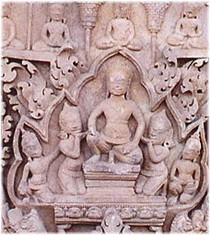 Detail from a lintel at the Battambang Provincial museum
 Battambang's Museums
The city of Battambang is blessed with two museums, the main Provincial museum located on the west bank of the Sangker river, which is open daily except Monday, and a second museum in the grounds of Wat Po Veal pagoda on the opposite bank of the river. On two previous visits to Battambang in 1999 and 2000, the main museum was padlocked shut and no-one had the key to open it up so I was restricted to inspecting the half dozen lintels and two lions - which are all of good quality - housed on the steps of the building. My disappointment of previous years was certainly swept away when I arrived in Battambang on this occasion and engaged the services of Sak as my guide. Sak used to work at the museum before his current job in the city's planning office, so he was more than keen to show me around and in addition to that, when we arrived at the museum at 2.30pm - just two hours after getting off the bus from Pursat - he arranged for a personal guided tour by the Province's Director of Culture and Fine Arts, no less. Now that's what I call first-class customer service. The Director is Tub Tan Leang and he spends most of his days at the museum - whereas most officials at his level spend them in their opulent government offices - but Leang isn't your usual government official. Instead, he's a man whose passion for his museum and its priceless contents was obvious the moment I met him.
For the next two hours, the three of us inched our way around the museum's exhibits with Leang and Sak filling me in on each item's provenance where it was known, and in many instances its meaning, as in a lintel displaying the Churning of the Sea of Milk. Leang is better-versed in French with English harder for him, so Sak helped him out when required and it was clear to me that the two men got on very well, displaying an almost telepathic connection between them. Leang gave me the okay to ignore the 'no photographs' signs - something that would be unthinkable at the National museum in Phnom Penh - as I snapped away in a veritable treasure-trove of artifacts that included many lintels in fantastic condition such as the one from O'Taki, inscribed steles, a magnificent polished linga, lions, boundary stones, heads of gods from the causeway at Banteay Chhmar, other sculpted figures and a massive urn to mention just a few. There was also a collection of wooden buddhas and the most recent addition, a large head that had been found buried in the garden of the museum in the last month, presumably to avoid its theft by the Khmer Rouge. He told me that the museum opened its doors in 1968, only to close during the civil war and re-open again in 1986, undergoing a refurbishment in 1997. I felt privileged to be afforded such VIP treatment though it was obvious that Leang enjoyed talking about his exhibits as I did listening. With much of the museum's sculptures coming from the Angkorean temples that dot the landscape around Battambang, the museum is an important part of the jigsaw to fully appreciate a visit to temples like Ek Phnom, Phnom Banan and Wat Bassaet. We left and headed straight for Wat Po Veal on the other side of the river, wishing to visit the museum on the ground floor of the main vihara, only to be informed that the head monk was visiting the doctor and no-one could give us the key. It was case of deja-vu from my previous Battambang visits. Undaunted, we promised to return.
A couple of days later, we returned to the pagoda at 3pm and with great perseverance, Sak eventually tracked down the monk with the key to unlock the heavy padlock on the museum door. His name was Roeury Rien and he told us the museum was rarely opened but he'd be happy to let us in. Judging by the dust and cobwebs everywhere, the monk was right that the exhibits saw no visitors, as half a dozen monks also took advantage of the open door, to wander in with us. Inside we found another fifteen lintels, some upside down and all covered in dust, a beautifully carved boundary stone with an inscription and lots of other sculpted items. A real Aladdin's Cave of treasures, and I wondered if it's used as a storage holding area before the pieces can be exhibited at the main museum. I couldn't establish if the two museum's work hand in hand with each other, but I was aware that the museum was first opened in 1965 and it was clear that this building needed a good spring-clean if it was going to open its doors to visitors on a regular basis. We thanked the monk, one of 120 at the pagoda, and I left Wat Po Veal feeling my museum-hunting had at last paid rich dividends on my third visit to Battambang.
Footnote: I urge you to make time in your schedule to visit both museums, you won't be disappointed. And contact Sak to be your guide, he proved to be excellent.
Link: Cambodia Tales.
