Friday, June 22, 2007

Seeing friends in Battambang

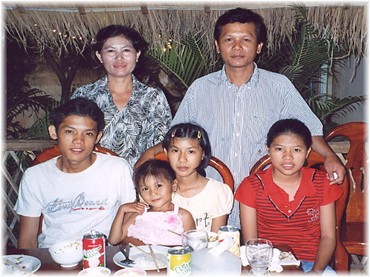
LtoR (back row); Theara and Sak; (front row) Chamnap, Holly, Chakrya and Borromey.

I've just posted this travel tale from my January 2007 trip to Cambodia - my 13th visit in as many years - onto my website. I keep kicking myself for not getting all of my stories written, posted and accompanied by my photos, but I'm getting there! In the meantime, I hope you like it:
Seeing friends in Battambang
Leaving Phnom Penh’s coach station at 8am, the bus to Poipet stopped outside Pursat for a bite to eat after three hours, with still another 100 kms to Battambang, my own stopping-off point. We finally pulled into the Sorya bus office at 1pm with my friend and local guide, Sak waiting to greet me with a hug and a beaming smile. I booked into one of Battambang’s newest hotels, the Golden Palace ($13 for twin room), some 200 metres from the east bank of the Sangker river and then took lunch, chicken curry, at the tourist-popular White Rose restaurant in the centre of town. As ever, the café was busy, the service was laboured though I did notice a resemblance of the heavily-pregnant female owner to Marina, the heroine of the children’s television show Stingray! I popped next door to renew acquaintances with Chhorvy, the friendly owner of the KCT internet shop. I took a shower back at the hotel and by 4pm was at Sak’s home, where he proudly showed me the concrete foundations and described his brand new house – one storey, two rooms – on land given to him by his parents, who live a couple of metres away. Work had begun twenty days earlier but will only continue when he has funds to pay the builder. Sak’s wife Theara cooked us pork and vegetables and we ate in the open-air in his garden, with his well-behaved children home from school and busy with their homework and chores. With his job at the town planning office, supplemented by a few foreign tourist-guiding jobs, he’s been able to send them for extra tuition at a private school again. I was back in my hotel by 9.30pm and with two electricity power cuts in quick succession, I took the hint and retired to bed.
Up at 6am, I had an omelette and coffee in the Green House café next to the hotel before a 7.30am start with Sak and his moto, as we headed for one of the small satellite railway stations. By 8am we had climbed aboard a norry – aka, a bamboo train - at Ou Dambang Mouy with fifteen locals and were rattling our way south towards our destination, Phnom Thipadei, on the way to the town of Moung Russei. I sat on a pile of rice sacks for protection against the bumpy ride and made friends with my fellow passengers as Sak kept a tight hold of his moto. Two oncoming norries were dismantled to let us pass because we had the moto but an hour and fifteen minutes into our ride, it was our turn to remove our wheels and wooden platform from the track to let through a convoy of five norries, loaded with goods and people. Just after 9.30am, we reached our destination, paid our couple of dollars and waved goodbye, as we headed for the top of the nearby Phnom Thipadei, eliciting surprised smiles from the quarrying families at the foot of the hill. Wat Sovann Kiri was at the top of a 300 step climb which presented us with wonderful views over the surrounding countryside and a welcoming breeze, though the colourful vihara at the top was locked with no-one around to open it up. It took another hour to reach Moung Russei town itself, arriving at noon and after a brief look around Wat Soriyaram, a brightly-decorated pagoda on the main highway with lots of statues in its grounds, we headed for lunch, chicken and pork, at a roadside stall. Around the corner we visited Theara’s grandparents house and met a visiting relative from Long Beach, California, before stopping at Wat Chrey, located in a pretty setting alongside the river, at 2pm. This wat had even more colourful statues surrounding the vihara and a helpful monk, Kim Chea, showed us a killing fields stupa where one skull remained – the other victims’ remains having been cremated in 2001 on the orders of the head monk.
Heading further east towards the Tonle Sap lake, we called into a couple of wats along the track, surrounded by bright green paddy fields and a smile on everyone’s lips. Nearly two hours into our ride, we arrived at Wat Daun Tri North, which turned out to be a fascinating location. Used as a Khmer Rouge hospital, Chhen, the old gentleman who guided us around, told us that bones often wash up out of the ground in the rainy season, when much of the area floods as the Tonle Sap lake dramatically expands in size. I spied a quartet of sandstone pedestals and Chhen confirmed the pagoda was built on the site of an Angkorean temple, Prasat Daun Tri. He took us inside the vihara, where a small sculpted antefix in prasat form in red sandstone stood on one side of the main altar. A space on the opposite side signalled where a “beautiful carved stone with a thousand buddhas,” in Chhen’s words, had stood until it was stolen at night by thieves just three months before. This raised for me the difficult conundrum about whether valuable items like that should be kept in their original location – which seems right – or moved to a safe location like the National Museum – which seems sensible. I am still debating this in my head! Meanwhile, Chhen wasn’t finished and led us outside again to show us three sandstone lintels, one of which was in excellent condition with Indra atop Airavata, and a Sanskrit inscription. We thanked Chhen and the crowd that had joined us at the pagoda and headed back towards the main highway, about ten kilometres due west, stopping en route at Wat Ta Loas Chass to visit the elaborate killing fields memorial stupa in the grounds of the pagoda. The fifty kilometres back to Battambang took us just forty-five minutes as Sak put his foot down. I revisited the White Rose for my evening meal, KCT for my emails and a tikalok fruit juice at one of the foodstalls located along the riverbank.
At 8am the next morning, Sak and I met up with an old friend, Tub Tan Leang, the Province’s director of culture and fine arts at the city’s museum, where he explained in detail the contents of two stele, or inscription stones, including one from Daun Tri, which we’d visited the day before. I also spotted that two lintels and one linga were absent from the display and he said they’d gone with an Angkor exhibition to Europe. He agreed with my suggestion, that a photo and explanation about their absence was a good idea to help visitors. At 8.30am, we headed south of the city, along the river, to investigate three villages that have been designated ‘community villages’ in a drive to improve the tourist options around Battambang. Our first stop was in Ksach Poy village, ten kilometres from the city, which is being promoted as an agricultural area. We took the back road, making sure the river was always in sight and stopped for a chat with a farmer and his wife, who were growing a variety of foodstuffs on their plot, including corn, potatoes, oranges, grapefruit, mango, jackfruit, banana and coconut, having bought their hectare of land for $10K just four months before. Our other reason for visiting the village was to see the House of Light & Knowledge, headquarters of FEDA, where Sandy, the English teacher, showed us around their new and well-appointed facility for half an hour. FEDA is a grassroots NGO working to empower rural people in the area, they employ fifteen staff and no less than 700 children take advantage of the three classrooms, library and other facilities, at one time or another. At another stop, mainly to evade the incredibly dusty road, we called into a women’s handicraft centre where we watched them making sarongs and they laughed at my feeble attempt to work the loom.
On our way back to the city, we passed through Kompong Seima, another agricultural and fruit-growing village but decided to stop in the village of Watkor, where at least five ‘ancient’ or traditional wooden houses are open to the public. The house we viewed wasn’t exactly ancient, built some sixty years ago, but the female owner was very welcoming and showed us around her sturdy home on stilts and some of the older objects like a rice machine and ox-cart that were in her courtyard. By 11am I was back, checking my emails at KCT, followed by lunch at the White Rose and then back to my hotel for a short nap. At 2pm, I returned with Sak to the museum to spend a couple of hours with Tub Tan Leang, where he took me on a tour of his favourite pieces in the museum’s collection, giving me their history, provenance and how they’d arrived at the museum. He also opened up the museum’s storage area for me to see where numerous pieces are kept that aren’t quite up to display standard. Judging by the cobwebs and large spiders on show, its not an area that is opened very often. Leang is a man who clearly loves his work and it was a pleasure to spend time with him once again. Sak and I enjoyed a tikalok at the riverside as dusk fell and followed that with a 6.30pm dinner appointment with his family at the KO restaurant, close to La Villa hotel and the east bank of the river. Our party of seven – myself, Sak, Theara, as well as their children, Chamnap, Chakrya, Borromey and Holly - were seated some way from the stage where five singers and a band did their level best to burst our eardrums, making conversation virtually redundant. Nevertheless, our meal, various dishes and cans of soft drinks, was tasty and cost just $15. The meal was my thank you for the hospitality his lovely family show me whenever I come to Battambang. We finished the meal by 8.30pm and I returned to my hotel room to watch football on the tv. You might just get the impression that not much happens in Battambang after 9 at night.
For my final day in Battambang, we decided to head north to visit some of Sak’s relatives in Monkolborei. After breakfast at the Green House café, we left the city at 8am, along the main highway towards Sisophon, with the railway line running in parallel alongside us. After forty-five minutes, we stopped at the main wat in the small town of Tapoung for directions to the two temples of Prasat Sel Nguor; backtracking three kilometres before heading west along a dusty track for another three kilometres. In the village of Tuol Prasat, we were shown the site of an old prasat, likely Prasat Sel Nguor East, where just a few sandstone and laterite blocks and a pedestal in the bushes remained and were told that four temples in the area had been completely destroyed during the Khmer Rouge regime. We scouted around some of the homes in the village, which houses thirty families, but without success apart from spotting a few more scattered sandstone blocks. Back on Highway 5, we arrived at Banteay Neang at 10.30am and walked up the steps to the pagoda behind the large Buddha statue, where a nun showed us a small collection of human bones found when clearing a well, and a Sanskrit inscription on the side of a large boulder, one of many which provide a series of caves full of small shrines.
We rolled into Monkolborei town at 11.15am and headed straight to the village of Phasysra, where Sak had lived as a boy with his father’s relatives for four years during the Pol Pot regime, a stone’s throw from the Monkolborei river. Warmly welcomed at two houses, where at the latter, his aunt was making rice wine, we drove to nearby Wat Anchan, where Sak explained he’d lived for a while and was forced to destroy Buddhist statues by the Khmer Rouge cadres, and severely punished after he ran away, being locked inside a burial stupa for two days. Our lunch was provided by his sister in law and her husband, Nouv and Jantou, and their adorable daughter with a delicious chicken curry, prepared especially for me. Once again, I was truly touched at the great lengths people go to make me feel so welcome throughout this wonderful country. On the way back to the main highway, we stopped at the site of Prasat Preah Srei, located behind a school, where a few sandstone blocks, a broken colonette and a pedestal were all that was left of an Angkorean temple. By 3.30pm we were back in Banteay Neang and took a look at a small hill, Phnom Thom Prasat, where we found a few pieces of sandstone and a circular pedestal, sat next to a newly-painted blue pagoda. We were back in Battambang just before 5pm. A little later, and fast becoming a creature of habit, I called into KCT and the White Rose and then visited a friend of Sak who showed us around his house, which he was looking to let, with Sak acting as landlord. I was tucked up in bed a little after 9pm. Next morning, I was up and packed by 6.30am as Sak arrived and took me to the boat-dock for my 7.15am departure. He’d purchased my ticket for a few dollars under the usual $15 tourist fee and after saying our goodbyes, myself and thirty odd passengers, a mixture of locals and foreigners, left the dock on our Angkor Express boat bound for Siem Reap, and the next chapter of my adventures.

Happy People

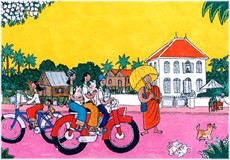
Instantly recognisable is the happy painting cartoon-like style of artist Stephane Delapree that is widely available throughout Cambodia. Delapree, alias Stef, brings the fun and colour of Cambodia into his work - happy monks, happy mothers in hammocks, happy women drying laundry, happy people driving motorbikes, happy cyclo drivers and their passengers, the list is endless. Born in Paris in 1956, he grew up in Quebec and moved to Cambodia in 1994, opening his first gallery in the lobby of the Sofitel Cambodiana Hotel a year later. There are now seven galleries selling his exclusive designs in-country, the newest being at Pochentong's International Airport in Phnom Penh. And his most recent work is focused on a brand new line, Happy Laos. Stef produces hand made limited edition serigraphs of some of his works on t-shirts and on hand made mulberry paper in acrylics, oils and ink, as well as original paintings and accessories. His success comes from his very own unique style, which you can find out about at his website.

Thursday, June 21, 2007

Arts update

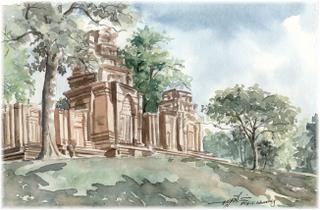
This a painting of Prasat Kravan, in the Angkor temple complex, taken from the blog of Poy Chhunly, one of the winning filmmakers in last weekend's Cambofest Film Festival, held in Phnom Penh. Poy, 28, is primarily an artist, originally from the PHARE School of Arts in Battambang, and now living in Siem Reap. He co-directed with Yannick Zanchetta to win the Best Local Showcase Award for their film, 'Little Boy Drinking Bad Water.' Another winner was 'The Golden Voice' in the category Best Short for director Greg Cahill, who attended the festival. It was the first festival of its kind in Cambodia and will be repeated, with some new additional movies, in Siem Reap in late October. Link: Cambofest.

* * * * *
Loung Ung will make a rare appearance in the UK to speak about her second memoir, After They Killed My Father (aka Lucky Child) at the Edinburgh International Book Festival on Sunday 19 August (7-8pm). Tickets are now on sale and the Festival will run from 11-27 August. The Edinburgh International Book Festival began in 1983 and is now a key event in the August Festival season, celebrated annually in Scotland's capital city. Biennial at first, the Book Festival became a yearly celebration in 1997. Throughout its 23-year history, the Book Festival has grown rapidly in size and scope to become the largest and most dynamic festival of its kind in the world. Link: Book Festival.

Wednesday, June 20, 2007

The Monkey Man

Thavro Phim is a distinquished classically-trained Cambodian dancer . He entered Cambodia's School of Fine Arts in part because he was from a long line of prominent Cambodian artists - his great-uncle Hang Tun Hak was Rector of the Royal University of Fine Arts, a respected playwright and the country's prime minister; his great-great uncle, Sang Sarun, was the country's most famous lakhon bassac (folk opera) star; and his father, Phim Chhieng, was one of the founders of the Royal University of Fine Arts. Thavro became a dance faculty member of the University of Fine Arts - he taught classical and folk dance and performed abroad with the school's troupe. Part of the first post-war generation in Cambodia to study traditional dance, he and his peers crisscrossed the Cambodian countryside, performing as part of the government's plan to capture the hearts of its impoverished and war-weary populace, and to offer them a sense of continuity and history through old mytho-historical dramas, comic interplay, and folk dances. In 1993 he relocated to the United States and has taught and performed widely, including San Jose, California, where he started a class for boys in both the 'monkey' role in Cambodian dance and chhayam, comic improvised dance and drumming. He is one of only three professionally-trained Cambodian dancers specializing in Hanuman, the magical white monkey role, living in the US. He moved to Philadelphia in December 2001 and is a resident artist for the Philadelphia Folklore Project.


His story was told in the 1999 documentary film by director Janet Gardner called Dancing Through Death: The Monkey, Magic and Madness of Cambodia. Thavro was just three years old when Pol Pot came to power and enforced his genocidal regime. He lost his father, brother and grandfather to the Khmer Rouge. The documentary looks at Cambodia’s cultural history and the ancient empire of Angkor when the Khmer ruled most of Southeast Asia. It takes its audience through the Pol Pot years and conveys the preciousness of the dancers who survived the country's maelstrom. It tells of the transmission of a culture from generation to generation, mourning for what was lost and celebrating the dance that has survived in the midst of death, displacement, and turmoil. Thavro and his wife, anthropologist Toni Shapiro Phim, who studied dance in the refugee camps on the Thai-Cambodian border herself, also tell the story of their work together, their romance and eventual marriage. Read a review of the film in the Comments section.

Tuesday, June 19, 2007

Gap Year Peril

Earlier this evening, British television aired a Tonight Special on ITV called Mind The Gap Year as thousands of students prepare for rite-of-passage trips to exotic locations. The programme followed the journey of Jo Gibson-Clark to Cambodia, where her son Eddie disappeared nearly three years ago, as her desperate search exposes the hidden dangers faced by young Brits seeking adventure. Eddie Gibson has not been heard from since 24 October 2004 when he emailed his mother to say he was planning to return to the UK and despite massive television and newspaper coverage and a poster campaign in Cambodia, Eddie has not been found. For more information on Eddie's case visit their website here.

Monday, June 18, 2007

Survivor stories

Publication of stories from survivors of the Khmer Rouge regime in Cambodia have been on the increase in recent years, as the worldwide focus on genocide survivors around the globe has risen to a level where its important for everyone to understand what took place, so it can never be allowed to happen again. Despite their often horrific nature, book publishers are now much more willing to publish these accounts of life and loss under a genocidal regime, and two such books arrived on my doormat this week. My thanks to Heaven Lake Press who've sent me Sam Sotha's memoir, In The Shade of A Quiet Killing Place, published in March this year; and to Kim Chou Oeng and his self-published story, Climbing Back Up: The Killing Fields of Cambodia and Phnom Dangrek The Untold Story, as told to Marchelle Hammack, and published in 2003.

One set of survivors who've always intrigued me since my first visit to the Tuol Sleng Museum in 1994 are the S-21 Seven. Initially, it was thought just seven prisoners held at Tuol Sleng survived out of up to 20,000 inmates, though in later years DC-Cam have suggested that the correct figure should be fourteen. Part of an article from German news media Spiegel Online in January 2007, included details of one of those survivors, Nhem Sal:
Cambodia Prepares for Khmer Rouge Tribunal by Jürgen Kremb
Pol Pot and his minions committed mass murder against their own people. Now, an international tribunal is to judge the regime - what some people call the first legal reckoning with communism. Can justice be served, 30 years on? Memories plague farmer Nhem Sal, 50, even in his sleep. He feels the pain in his ankles and wrists, as if his teenaged Khmer Rouge warden were still tying him to the bare metal bed on the third floor of Block A, in the infamous torture prison Tuol Sleng. The camp was called "S-21" -- and it was the center of terror in Pol Pot's regime. More than 30 years have passed since then.
Nhem Sal (right) feeds his family with rice he grows himself. He is about 1.70 meters tall, has a thinning lock of hair over his forehead, and his hands are covered with calluses. His straw hut is in the province of Takeo, some 60 kilometers south of the Cambodian capital, Phnom Penh. A year ago, authorities came to his yard and told Nhem Sal he'd been chosen to serve as a witness for the international human rights tribunal, officially known as the Extraordinary Chambers in the Courts of Cambodia (ECCC). Finally, in early 2007, after years of difficult talks between the government of Hun Sen and the United Nations, the last survivors from the so-called 'Democratic Kampuchea,' the regime of the communist mass murderer Pol Pot, will stand before an international court in Phnom Penh. For a quarter century, state prosecutors have been sifting through trial documents, and now they want to take depositions from the first witnesses. The crimes committed were monstrous. Almost half of Cambodia's population of 7 million died in Pol Pot's barbaric attempt to turn his country into the ultimate communist society, says Prime Minister Hun Sen. Foreign experts consider 1.7 million to be a more probable figure for the number killed. Nhem Sal's visitors said only seven of the approximately 20,000 inmates of S-21 survived the torture camp. Five are still living, and Nhem Sal is one of them.
Nationalist fervor
In the spring of 1970, all the farmers in his village stood around the only radio and listened to the voice of Prince Sihanouk, speaking to them from distant Beijing. US vassal General Lon Nol had staged a putsch against him, said Sihanouk, and he urged the youth to liberate their homeland. Cambodia had become enmeshed in the Vietnam War. American B-52 bombers had dropped 500,000 tons of explosives on the country in the late 1960s, to destroy lines of communication with the Vietnamese communists that ran through Cambodia -- more bombs than were dropped on Japan during World War II. After Nhem Sal and his friends heard the prince on the radio, they took off for the jungle and joined the Khmer Rouge. Five years later, they had won, taken over the capital and driven the population into the countryside, where they were to live out true communism. It was the start of a ruthless campaign of genocide against Cambodia's own people.
Five months later, child soldiers - not unlike Nhem Sal and his comrades themselves - arrived at their camp and accused them of being "spies for US imperialists." After a brief interrogation, they shot Nhem Sal's supervisor. He ended up as "fertilizer for the rice fields," as his executioners cynically put it. Nhem Sal was thrown on a truck and taken to Tuol Sleng prison. During the days he was tortured. He spent the nights chained to his cot. Unlike most of the others in the camp, he was suddenly released after a year to combat again with the Khmer Rouge in border fighting against Vietnam. The killing finally came to an end in December 1978. Vietnamese soldiers - headed by the Cambodian Hun Sen, a renegade from the Khmer Rouge - liberated the country from the orgy of bloodletting that Pol Pot had set in motion.
Now, 28 years later, Nhem Sal has returned for the first time to Tuol Sleng as he prepares to take the stand as a witness before the tribunal. White letters announce over the entrance: "Genocide Museum." On the ground floor are long rows of boards affixed with photos. All prisoners had been photographed by Pol Pot's guards upon their arrival at this tropical gulag, and their personal data noted. Nhem Sal spends some time examining the walls of photos, searching in vain for his own image. Suddenly his memories overwhelm him and he runs outside. [article continues....Link: Spiegel Online]
Note: S-21 survivors today are: Vann Nath aka Heng Nath, Chum Mey, Bou Meng, Nhem Sal, and Touch Tem.

Sunday, June 17, 2007

Critics view of Cambodia documentaries

Three of the newest documentaries about Cambodia to be screened at film festivals around the world come under the spotlight on the FIPRESCI (The International Federation of Film Critics) website. All three films have already been highlighted on this blog but its always good to read the view of an independent voice.

Cambodia on the Documentary Map - by Lars Movin
While the world is still waiting for the responsible Khmer Rouge leaders to be brought to justice, documentary filmmakers are now beginning to shed some light on various aspects of the often harsh realities of present day Cambodia, a country which is still struggling to overcome the crimes of the past. Khmer Rouge might have been reduced to some tiny fractions hiding out in the jungle, and Pol Pot might finally be dead and gone, but the effects of decades, if not centuries, of conflicts and wars, culminating in the four years of madness, violence and killings in the late 1970s, are still very visible in the once so powerful kingdom which in an ancient past produced wonders like the Angkor Wat. In recent years we have seen a number of documentaries on Khmer Rouge and their crimes, quite a few of them made by Rithy Panh, who was born in Cambodia in 1964. He escaped to Thailand in 1979 and is currently living in France. Among his most well-known films are titles like Bophana: A Cambodian Tragedy (1996) and S21, the Khmer Rouge Death Machine (2002), both very important insights into a not very long gone past, especially because three quarters of Cambodia's population is born after the fall of Khmer Rouge. If we consider these documents of the atrocities of Khmer Rouge to constitute a first wave of documentaries on Cambodia, what we see now could be regarded a second wave, focusing on the everyday life of the survivors and their children. Three new films fall into this category.

The most artistically accomplished of the three is Paper Cannot Wrap Up Embers (Le papier ne peut pas envelopper la braise, France, 2006), again by Rithy Panh. This time Panh has left the perpetrators and locations of the crimes of the past and entered a building somewhere in the slums of Phnom Penh where 300 young women live and work as prostitutes. Most of the women have come from the poor rural districts, uneducated and defenseless, looking for work and a better future, hoping to be able to send money back to their families. But instead they have been caught up in a vicious circle, selling their bodies for a few dollars (of which they receive only a small fraction), sinking into a mire of drug abuse, violence and self hatred, and being exposed to unwanted pregnancies, HIV and other diseases. Stories like these have been heard a million times before, but not told in quite this way. Panh moves in very close with his main characters, and obviously he has gained their trust. Except for a few short segments shot in the streets the camera stays inside the building, exploring the intimate life of the women between their jobs. They talk and play, cry and sleep, cook and eat. They put on make-up and prepare themselves for the next humiliating and painful encounter, and they dream about a different life or try to escape their fate for a few moments of drugged-out oblivion. Whatever the women do the camera just observes, in long steady shots, often in careful framings with beautiful colors, but at the same time with a constant, bluesy undercurrent of spleen and doom. The film runs for 90 minutes, and time is a crucial factor. As a viewer you really get the sensation of entering into this claustrophobic micro-cosmos, but at the same time the film has a feeling of being staged, a strange sense of subdued drama playing itself out somewhere between distance and authenticity and resulting in an almost eerie otherworldliness, which makes its characters linger in the memory long after leaving the soft darkness of the cinema.

A much more direct and conventional approach is found in New Year Baby (USA, 2006), a travelogue by first-time filmmaker Socheata Poeuv. Having been born in a refugee camp in Thailand , and later raised in Dallas, Texas, Poeuv grew up with very limited knowledge of the Cambodia her parents escaped. And a few years prior to the start of her film project she realized that not only did she not know much about her family's background, but in fact there was quite a lot she didn't even know about her most intimate family relations – like that her mother was not really her mother, and her sisters not really her sisters (but cousins). What she was brought up to believe was a tightly knit family was in fact a group of people pieced together of individuals who had all lost their real families to the Khmer Rouge. A family of fate rather than of blood. With these secrets out of the closet the Poeuv family sets out on a journey back to Cambodia , an odyssey, during which they not only confront the horrors of the past but also grow much closer to each other. The film is well structured and all its characters likeable, it is both lighthearted and entertaining and touching and sincere, but what makes it especially strong as a documentary is the fact that Poeuv has succeeded not only in weaving the difficulties of making a film with your own family into the fabric of her narration but also with her persistence and love to push her parents to a point where they undergo actual changes, both in their attitudes and their relationships – all during the course of the shooting.

The third and final film – Aki Ra's Boys (Cambodia, 2006) by James Leong and Lynn Lee – is less remarkable in an artistic sense than the two first, but nevertheless interesting for its subject. Cambodia is one of the most heavily mined countries in the world, if not the most, and since the collapse of Khmer Rouge in 1979 about 20,000 children have been crippled by landmines. One of them is Boreak who lost an arm when he stepped on a mine. He was eight years old, and after the accident his parents sent him to a home in Siem Reap for landmine victims. Leong and Lee follows the dynamic youngster who is trying to overcome his handicap by insisting on doing what all young boys do, and even more so. The film doesn't have much narrative structure, it mainly lets Boreak act out his tremendous energy in front of the camera, but it adds an extra dimension in the form of a reassuring relationship between the young protagonist and his older friend, Aki Ra, a former Khmer Rouge member who used to place landmines and now has dedicated his life to removing them, and to helping victims like Boreak. The three films are very different in their approaches, but seen together they show the contours, not only of a new generation of Cambodian born filmmakers, but also of a new generation of Cambodians who, even though they are born after 1979, are living with the grim past and dealing with all kinds of wounds – mental, physical, social and cultural – but who nevertheless are insisting on the hope of a better future. And, each in their own way, the films confirm why we need documentary filmmakers: to show us that behind the gruesome statistics of two million deaths lies not only faceless numbers and stereotypes of good and evil, but millions of individual stories all made up of complex combinations of all kinds of feelings, moods and character traits.
Lars Movin© FIPRESCI 2007
Lars Movin, based in Copenhagen, is a critic, writer and documentary filmmaker. He has been writing about film and other subjects since 1983, in later years specializing in documentary films. Link: FIPRESCI

Saturday, June 16, 2007

The White House on Sichan Siv

In May, I posted an exclusive interview with Sichan Siv, the Cambodian-born former United States Ambassador to the United Nations, whose inspiring story will be published in his memoir, due out in March 2008. You can read the interview here. The latest publication to highlight his career is the June edition of The White House Asian Pacific American Newsletter, direct from Washington DC. The month of May was designated Asian Pacific American Heritage Month in the United States and Sichan Siv is the embodiment of that focus on their contribution to the American nation. Here's what The White House Newsletter said about Sichan Siv:

One month before America’s Bicentennial, Sichan Siv arrived in Wallingford, Connecticut with two dollars in his pocket. Before that, he had spent a few months in Thailand teaching English to fellow refugees in a camp, and learning Buddhist precepts as a monk in a nearby temple. The previous year, he survived two Khmer Rouge death sentences and their slave labor hell, working 18 hours a day with just one meal. He had missed the last U.S. evacuation helicopter by 30 minutes on April 12, 1975, when he chose to attend a meeting to arrange food and medical supplies for some 3,000 stranded refugee families in an isolated province. When he was a child his mother told him to “never give up hope, no matter what happens.” Hope kept him alive and helped him move forward in these most difficult circumstances.

On June 4, 1976 Siv arrived in his Promised Land, completely exhausted but full of hope. He started his new life at the bottom of the ladder. He picked apples in Connecticut and drove a taxi in New York. He was eager to do everything that came his way, in order to “adapt and be adopted.” In the meantime, he was awarded a scholarship to Columbia University’s master of international affairs program. Siv became interested in the U.S. political process while watching television coverage of the Democratic and Republican national conventions in the summer of 1976. In 1988, he volunteered for the Bush campaign to better understand presidential elections. The thought never crossed his mind that he would end up working for two Presidents of the United States. On February 13, 1989, exactly 13 years after he began his escape through the jungles of northwest Cambodia, Siv became the first American of Asian ancestry to be appointed a Deputy Assistant to President of the United States, under George H.W. Bush.

In March 2001, President George W. Bush appointed Siv as a delegate to the 57th U.N. Commission on Human Rights. In October of the same year, the President nominated him, and he was unanimously confirmed by the Senate, as the 28th U.S. Ambassador to the United Nations Economic and Social Council. Until 2006, he concurrently represented the United States at the U.N. General Assembly and Security Council. His responsibilities ranged from cradle to coffin: children, health, HIV/AIDS, economic issues, food crises, humanitarian disasters, human rights, refugees, women, and aging. The United States is the largest donor to all these programs and Ambassador Siv’s office at the U.S. Mission to the U.N. oversaw some 70% of the U.N. budget.

In June 2005, Ambassador Siv addressed the 60th anniversary of the U.N. in San Francisco, following a tradition set by Presidents Truman in 1945, Eisenhower in 1955, Johnson in1965, Secretary of State Schultz in 1985, and President Clinton in 1995. In addition to his three presidential appointments, Ambassador Siv has had a distinguished career in the private sector, encompassing refugee resettlement and educational exchanges, as well as financial management and investment banking. In his spare time, he travels around the United States and the world speaking about the American Dream, to motivate and inspire. While at the White House, Ambassador Siv was proudest when he said “On behalf of the President.” At the United Nations, when he walked in, representatives from 190 countries looked at him and saw America. They wanted to hear what he had to say. When he uttered: “On behalf of the President, Government, and People of the United States,” that was his proudest moment.

Ambassador Siv is the author of Golden Bones which will be published in the spring of 2008. It recounts his journey from humble beginnings in a sleepy village in Cambodia, to the White House, and the United Nations. It is about an extraordinary escape from hell in Cambodia, an American journey from apple orchards to the White House, a timeless and universal tale of love, dreams, hope, and freedom. It is the unique history of two lands: opposite sides of the earth; two cultures: ancient and modern; two nations: weak and strong; two societies: poor and rich. It is the true story of one mother’s love and sacrifice, of her son’s hope and struggle for survival, and of his life between these different worlds. Ambassador Siv is married to the former Martha Pattillo of Pampa, Texas. They live in San Antonio, Texas.

Friday, June 15, 2007

Anida performs in New York

If you've not yet encountered the work of Cambodian Muslim American artist Anida Yoeu Ali/Esguerra, then you can catch her latest performance, Living Memory/Living Absence, at the National Asian American Theater Festival in New York this weekend. Anida, who recently changed her last name to Ali from Esguerra to honor the recent passing of my grandmother, uses a multi-discipline approach to creating art that mixes the visual, spoken and written into performed explorations of hybrid identities. A believer in the power of collective creations, she has founded Mango Tribe, Asian American Artists Collective-Chicago, the APIA Spoken Word & Poetry Summit, I Was Born With Two Tongues and the MONSOON fine arts journal. She tours extensively, calls Chicago her home for now and made her first visit back to Camboda and her Battambang home in 2004. In her latest work being performed this weekend, she will deliver poetry with movement inspired by Butoh set against a video backdrop of the sites and sounds of her memories of Cambodia. Anida’s performance traces her poetic fears of returning to her birth country after 25 years of absence. The joy she feels immersed in ancient Khmer traditions clashes with the irreversible legacy of a genocide that lingers in the streets.

She says of her work; "While my performance experiences have brought me into a world rooted in writing and storytelling, my recent works use an interdisciplinary approach to creating art which mixes the visual, spoken and written into performed explorations of my hybrid identity. I am currently committed to exploring various artistic disciplines that will better inform my work as a multi-disciplinary artist who doesn’t easily fit into traditional boxes and as a writer who actively seeks interesting ways of storytelling." Visit her website for more info about this hard-working and barrier-pushing artist.

Meeting 'Brother Number Two'

Al Jazeera International, the 24-hour English-language news and current affairs channel, headquartered in Doha, are currently producing a series of reports from Cambodia in the form of their award-winning news anchor and presenter of their dynamic 101-East documentary programme, Teymoor Nabili, who joined the channel after experience with the BBC in London and CNBC in Singapore. Al Jazeera is funded by the Emir of Qatar. Here's Nabili's latest report from his visit to Pailin, in Northwest Cambodia, fresh from the news that the Khmer Rouge Tribunal has received the green light to begin in earnest.

Meeting 'Brother Number Two' - by Teymoor Nabili, in Pailin for Al Jazeera
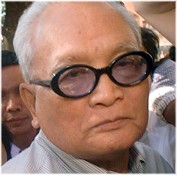
The remote district of Pailin, in north-western Cambodia district is still dotted with no-go areas almost a decade after the last remnants of the Khmer Rouge finally surrendered to the government. Nonetheless regional politics in this isolated corner of Cambodia, close to the border with Thailand remain under the influence of former revolutionaries. Which is why one of the 20th century’s most notorious figures has been able to live an untroubled life here. But contrary to local rumour, the home of Nuon Chea (pictured), the former "Brother Number Two" of the Khmer Rouge, is guarded only by an unimposing sign. On our visit we found little evidence of his supposed personal guard force. Now in his 80s, Nuon Chea is a frail figure. He insists on hiding his eyes claiming they are too sensitive to light. But if he is physically frail, mentally he remains sharp. During our long conversation, his defence of the Khmer Rouge was robust and even though he does admit some mistakes were made, he is keen to confuse the issue.
Big Mistake: "I don't deny that I'm responsible," he told me. "I personally take responsibility for the bad fortune of the people during the three year period but I want to stress, what is wrong, what is right. "My mistake is that I did not get involved with the lower levels so was not able to discover that there were bad men hiding among the people. We did not go into the local level. This was a big mistake. "In Khmer we say, if you are careless, you lose, we had no intention of killing our people. We wanted people to have food and clothes and education. The bad people hid themselves among our people and killed them." With Cambodian and international judges having now agreed the rules to try former Khmer Rouge leaders, Nuon Chea's defence then will rest in part on the argument that victims were in fact enemy infiltrators – bad people – and not innocent civilians. The other key part of the defence will be denial. He claims that the notorious Tuol Sleng prison, or S-21, was the responsibility of other Khmer Rouge leaders.
Torture: They include men like Duch, the former head of the feared Santebal secret police, and Son Sen, the former defence minister, who reportedly developed the Khmer Rouge's own techniques for torture and interrogation. Duch, though, has said that Nuon Chean personally authorised the torture of the estimated 14,000 people who passed through Tuol Sleng. So what exactly is the purpose of torture in creating revolution? On this the former Brother Number Two is evasive. "I know S21, this I know," he says. "As for torture I don’t know, because I was not in charge of this. Son Sen was directly responsible for the prison because he was minister of defence and internal security at the time.” So he knew nothing about S21? "I knew. I didn’t mean I didn’t know about it. I didn’t know any details about the torture. I was just aware of the place in general." Photos on the wall suggest Noun Chea has made his peace with one time foe Prince Sihanouk and he seems to see no irony in playing with his grandson’s toy weapon but his most jarring comment is that he once considered becoming a buddist monk.
'Remorse': Buddhism is a faith of compassion, I ask him, so does he feel remorse for the souls that were lost and for the suffering? "I have remorse, I have regrets," he says. "It should not have happened. We tried our best but it happened like that against our intention." As the international court builds its case against him, Noun Chea says he is fully prepared to face his accusers. "If I wanted to flee, I would have done it a long time ago. Where would I go? I could flee in just one step to the Thai border. It’s near my house." The border with Thailand is indeed a few minutes drive from Nuon Chea's house. In the past, certain refuge would have been a matter of a short stroll away. But with the global spotlight now intensifying on Cambodia, and on Noun Chea in particular, it is now far from certain that he would even get past his own border security.