Thanks to Loung Ung's blog on her own website, she reminds me of a book that I have yet to read, namely Bree Lafreniere's acclaimed account of the life of Daran Kravanh in Cambodia's killing fields, in the book, Music Through The Dark : A Tale of Survival in Cambodia. Its not a new book, it was published in 2000, but somehow it slipped through my clutches and I must get hold of a copy. You can find out more about it at this website.
Daran Kravanh was born in Cambodia in 1954 into a family of musicians. During the reign of the Khmer Rouge, his parents and siblings were killed. Kravanh himself narrowly escaped execution when he found an accordion, an instrument he learned to play as a child, and was ordered to play by Khmer Rouge soldiers. He left Cambodia for Thailand in 1984, lived in refugee camps for four years and eventually arrived in the US in 1988. Kravanh received his BA from Evergreen State College in 1996, has served as a human rights commissioner and works as a social worker in the state of Washington. He volunteers extensively in the community and is the president of the Cambodian American SupportNetwork. Meanwhile, Bree Lafreniere served as a Peace Corps volunteer in the Solomon Islands. Upon her return to the United States, she began working with refugees, and in 1992 met Kravanh through the Refugee Assistance Program of Tacoma, Washington. His accounts of life in Cambodia, genocide and surviving the killing fields were so powerful she felt compelled to tell his story in the book. Lafreniere also works as a social service administrator.
Thursday, April 12, 2007
Survival through music..and dance
Wednesday, April 11, 2007
And the music lives on...
Music plays a large part in my life, so I will share with you some forthcomings gigs I'll be attending. Tomorrow night (Thursday 12 April) I'll be making my way to Bilston in Wolverhampton to watch Legend at the Robin 2 club (band on stage at 9pm, cost £8.50). They're an eight-piece band of musicians and singers, led by Michael Anton Phillips, whose two hour show covers the very best of Bob Marley’s timeless classics like Is This Love, No Woman No Cry, Waiting in Vain, Exodus, I Shot The Sheriff, Jamming and Could You Be Loved. They also happen to have in their ranks, talented singer Leonie Smith, one of my very favourite female vocalists. You can usually find Leonie taking lead vocals with the band Gabbidon. Read all about Leonie here and find out more about Legend at their website.
Next week will find me winging my way to one of my regular venues, The Drum in Birmingham, on Tuesday 17 April, to watch the film, Who Shot the Sheriff, the story of the Rock Against Racism movement featuring unseen footage of artists of the 70's and the Love Music Hate Racism (LMHR) movement today. Groups like Steel Pulse, Sham 69, The Clash and Ms Dynamite will be featured. The film tracks the rise of racism and the National Front in Britain and how a generation, black and white, fought back. It starts at 7pm (tickets £4), there will be a post screening discussion and songs from Birmingham's very own singer songwriter Yaz Alexander, the Reggae Princess. Yaz is an extremely talented singer and will be back on stage again later that week, on Saturday 21 April, as the main support artist to Lucky Dube at the Aylestone WMC in Leicester (9pm-Late). On Monday 7 May, she will be back at the same venue as support to Beenie Man & Angel (9pm- Late). Read more about Yaz here.
Khmer film explosion
The number of feature films and documentaries being produced relating to Cambodia or by Cambodians these days is pretty staggering. I've just heard of two more and I'm sure there are many more out there that I haven't come across yet. If you do know of any, please let me know.
Let's start with an ambitious project by Sothea Studios who've produced a short 15 minute film called The Perfect Date, which is actually the precursor for a feature length comedy about a group of life-long friends, which will be called Finding Natalie. The short film is shot entirely in the Khmer language and is a unique blend of Cambodian and American cultures brought together by the power of comedy. It stars Jared Davis, Paula Danh and Sokham Dira and is directed by Nathaniel Noun. You can find out more about both films here. Also visit their myspace webpage.
The second project is a realistic and gritty feature film Power, Territory and Rice, in Khmer, English and Spanish, written and directed by Sojean Peou, with music and lyrics by Khmer rap star praCh. Sojean tells me, "praCh Ly is the force behind the making of Power, Territory And Rice as it is inspired by him. He's committed to writing new rap songs for the film. It will be shot in and around Long Beach, California on a micro-budget of $50K in October of this year." To find out more about this film, to be produced by Apsara Films, click here.
Tuesday, April 10, 2007
Showcasing Aki Ra's Boys
Another new film earning rave reviews at the current batch of film festivals taking place, Paris last month, Singapore this, is an hour long feature, Aki Ra's Boys by Singaporean duo Lynn Lee and James Leong.
Boreak was six when he lost his right arm in a landmine accident. Family members rushed the young Cambodian to a nearby hospital where so-called 'doctors' performed a crude amputation. Burdened with eight other children to feed and unable to cope with the stress of handling a crippled son, Boreak’s parents decided to send him to a home in Siem Reap for young landmine victims. This film looks at the world through Boreak’s eyes, and through the eyes of his good friend, Vannak. It is a world at once bleak and brimming with possibilities. Through Boreak, we also meet Aki Ra, a former child soldier, trained by the Khmer Rouge to lay landmines. Now in his 30s, Aki Ra is haunted by his violent past and hopes to make amends by giving children like Boreak a home, and by helping remove the millions of landmines still buried in his country. Ultimately though, the film is a celebration of a child's tenacity and indomitable will to overcome the odds. Boreak may be a victim, but he doesn’t behave like one. His zest for life is infectious, his ability to laugh, a testament to the courage and strength children can have in the face of adversity. Read more here.
Monday, April 09, 2007
Rithy Panh's latest movie
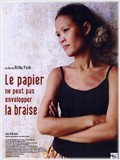
Last month, acclaimed Cambodian film Director Rithy Panh presented his latest movie to the International Film Festival and Forum on Human Rights in Geneva. Its also currently showing in France and film festivals around the globe. Le papier ne peut pas enveloper la braise (Paper Cannot Wrap Embers) is already receiving great critical acclaim and in this interview for Human Rights Tribune, Claire Doole finds out more about this latest docu-movie.
The film tells the story of seven young women forced to sell their bodies in the capital Phnom Penh to help feed their families living in poverty in the Cambodian countryside. Rithy Panh was 11 years old when the Khmer Rouge took over his country in 1975. He lost his entire family and was sent to a labour camp. After escaping to Thailand, he made for France, where he has made more than a dozen films dealing with the tragedy and consequences of the killing fields in which more than 1.5 million Cambodians died. His latest, “Le papier ne peut pas enveloper la braise” (“Paper Cannot Wrap Embers") is an intimate portrait of the women sexually exploited in a still traumatized society.
Why was it important for you to make this film?
I wanted to give these women a voice, to hear their thoughts and feelings. All too often people speak for them. You know I am often asked whether I scripted the dialogue, which disturbs me as it shows how people think they can’t speak for themselves. They can but few people ever ask them.
How did you manage to get access to the brothel?
I told them that I did not want to make a film about them, but with them. We got to know them over a period of one and a half years and I made it clear, that unlike their clients, we were not there to exploit them. It also helped that I got on with the brothel owner. I don’t condone what she does, but I sensed that as a woman, she knew what it meant to sell your body and understood how every time you do it, part of you dies.
Why did you choose to only film inside the brothel?
I wanted to concentrate on them and their daily lives rather than the sensational and sleazy world of the bars and pick up joints where they work. I did not want to make a film about prostitution but about the collective history of these women.
In the film, one of the girls recounts how an NGO persuaded her to testify against her father who raped her. She says that her only wish now is to see him walk free from prison. Do you think NGOs often impose their western values to the detriment of the Cambodians?
Yes this can happen. There are more than a thousand NGOs in Cambodia and while they are very good at emergency relief, they struggle with long term assistance. They are too fragmented and the government has failed to co-ordinate them. It is a jungle out there.
Some NGOs say reconciliation is more important than trying surviving members of the Pol Pot regime at a war crimes tribunal, what is your view?
Many NGOs want reconciliation as donor governments are keen to fund this. But that has no sense if there is still a culture of impunity. I don’t care if the former head of state, Khieu Sampham, is tried or not. That won’t bring back my family or repair the damage done. But we do need a tribunal that delivers strong judgement so that future generations can start to rebuild the country.
Do you believe in collective culpability?
No. Increasingly, perpetrators are being seen as victims. But that is wrong. People need to face up to their responsibilities.
The UN does not recognise that what happened in Cambodia was genocide. Does that frustrate you?
No one wants to call it genocide. So what? You could call it a crime against humanity. What’s the difference? Don’t forget the Khmer Rouge did more than just kill people, they took away their humanity.
What difference can showing the film here in Geneva make?
Films don’t change the world. But, it is certainly a step in the right direction if somebody changes his attitudes as a result of seeing it. It is important that the guys at the UN agencies in town come and listen to these women.
The UN estimates there are 30 thousand prostitutes in Cambodia. How do you see the future? I am more pessimistic than optimistic. It is so difficult to escape prostitution once you are in its clutches. The key is prevention, not cure. Helping poor women and children get an education is ultimately the solution.
Sunday, April 08, 2007
The demise of Sin Sisamouth
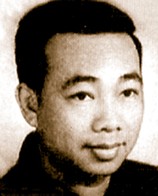
With the forthcoming bio of famous Cambodian female singer Ros Sereysothea about to be thrust upon us in the film The Golden Voice, it can only be a matter of time before a film of the life and times of Cambodia's revered male superstar, Sin Sisamouth, will be made. Sisamouth was the silky-smooth crooner who ruled the airwaves throughout the 60s and 70s during that golden age of Khmer film and music. His voice could be heard everywhere before his career, and those of most of the country's top artists, came to an abrupt halt with the arrival of the Khmer Rouge in power in 1975. Stories about the singer have been commonplace ever since, though a year ago, the story of his death, at the age of 40, came from a survivor of the killing fields that certainly carried a ring of truth. You can read the full story here in the archives of KI-Media. Sisamouth's music is also featured on the new documentary film Don't Think I've Forgotten, that celebrates that glorious period of Khmer music. For more background on Sin Sisamouth, click here.
Khmer hospitality knows no bounds
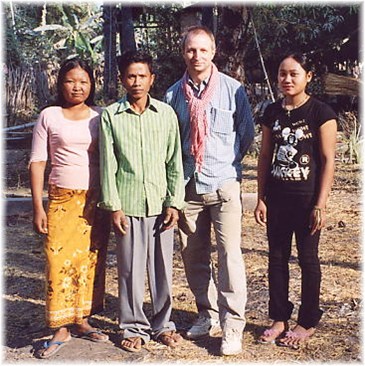
The family was headed by Phearng, who was the same age as me, 47, and was born in the village. He'd spent a dozen years in the ranks of the Khmer Rouge, as most of the 70+ families in the village had at one time or another. Sinoun, his wife, was just as gracious a host and they lived with four of their five children. Their eldest was Sinourt who now ran the drinks stall and had two children of her own. Next was Jana, just 20, was was getting married in a month and felt my presence was a good omen for her impending wedding. The other children were Golap 16, Bouty 12 and Vila 8. We feasted on chicken that evening and then fish with omelette in the morning. The photo above is one of about 50 we took of just about every conceivable combination of family, friends and me, the first tourist they'd ever met. In the morning, Phearng was our guide as we went searching for more remote temples, but it was him and his family who were for me, the real highlight of that particular part of my trip.
Saturday, April 07, 2007
Khmer takeaway
For three years I co-hosted a Magic of Cambodia day here in the UK, promoting Cambodia as a great destination and revelling in all-things Khmer for 1 day a year. It was a great success and amongst the successful ingredients was the Khmer food we laid on. That food was provided by a Khmer takeaway restaurant in Oxford called AK-City, so I was pleased to see an article in today's Guardian newspaper, all about AK-City. The restaurant is run by Steven and Lin Chung, at Cowley Road, Oxford (tel.01865 243028), and their signature dish is chilli and sweet basil, stir-fried with chicken at £4.15. Here's the article:
The world in a box
Steven: My grandfather is from China. He went to Vietnam and crossed over to Cambodia. I was born in Phnom Penh in 1957. I was there when the Americans were carpet-bombing in the early 70s. At night, we'd hear the noise of the bombing far outside the city. I remember the last few occasions it was very close and the whole house was shaking. That's when my father decided some of us had to go. I was sent away to school in Thailand. My parents stayed through the time of Pol Pot. Since I left, I've lost them both. We had no contact, nothing. I know that my father passed away - how, I don't know. A friend of mine from Cambodia, his auntie in Hong Kong, knows exactly what happened to my father. I keep saying one of these days I need to make a trip to Hong Kong to see her. I want to know, but it's hard for me ... Sometimes I feel guilt because of what he went through and I didn't.
My wife Lin was born in Phnom Penh, though her family is from China, too. We grew up together - the two families were neighbours. Years later, when I was working in England, I heard from a relative that there was a family in Cambodia asking about me. I knew immediately that it was them. I decided to find them. That was 1994 - I hadn't been back for 14 years. I found Lin, her mother and her sister. We married in 1995. I didn't expect that, it just happened that way.
Did you see The Killing Fields? It cannot show everything - it was much worse than that. Lin's family died of sickness and starvation, one by one - eight of them in the family, three of them left. My family was 10, and so far as I know there's only me, my sister in Australia and my brother in Japan left.
After 1975 it was really bad. Everybody was sent out of the city by the Khmer Rouge into the forests to get the land growing. If you refused to go, you would be gunned down on the spot. Some got killed just because they were educated. Anybody who spoke a foreign language had to be killed.
For me, life has just been a matter of change, going from place to place. My wife has been through so much more. She nearly got killed once just for stealing some potatoes; everybody had to do that - if you didn't, you would more than likely die of hunger. You worked from five o'clock until about three or four in the afternoon, and then they gave you one spoonful of rice with a lot of water in it. It was like that all the time up to 1979. Things got a bit better when the Vietnamese invaded Cambodia.
Lin: I think two months longer and I would have died, too. My hand was injured from a poisonous thorn. I couldn't walk, I was too weak. The Vietnamese came and they sent me to hospital. That's why I'm alive.
Steven: The main thing about being in this country is that you are free and at peace. You can do anything. You make a little money, you enjoy yourself, nobody bothers you. We have three children: Jenny is 10, David is eight and James is five. Jenny and David are both musical. They started violin nearly two years ago and this autumn they are taking their grade five.
Lin: My mother came by herself to Cambodia from China during the second world war. She was seven. She survived, she lived through everything that has happened in Cambodia, and now she is here with us in Oxford. She is very strong.
Steven: Physically strong and mentally strong. She likes the summer here. She loves flowers - she's never seen so many flowers. She's a good cook, too. I like cooking. My father was a chef in Cambodia - he cooked for weddings and receptions for friends and neighbours. My training was as a cobbler, but when I came over here in 1980, shoe factories were closing down; it was the wrong moment to be a shoe-maker. That's why I ended up cooking - first at a French restaurant in Covent Garden. I seemed to pick it up quite quickly, and then, when you see people enjoying their food, it becomes a passion.
I'd love to turn this place into a restaurant. A lot of my customers are students - a group of them like to come out and have a meal. In Cambodian cooking, you use lemon grass. Also coriander, galangal, turmeric. Quite a bit of the cooking probably came over from India. There have always been a lot of Indians in Cambodia. They come to trade. Angkor Wat was built by an Indian merchant more than 1,000 years ago [note: historically inaccurate]. Somebody from the East Oxford Action group painted a mural of Angkor Wat on the side of our building because before that people kept spraying graffiti. They don't any more. The name AK City is short for Angkor.

Remote temples in Preah Vihear Province
If you read any of my Cambodia Tales, you will know that I love to get out into the Cambodian countryside and discover for myself, some of the hundreds of ancient Angkorean temple sites that are dotted all over the landscape of that beautiful country. My latest visit, in January, was no exception and one such trip was my adventure with my trusty sidekick Sokhom, into the unexplored territory of Preah Vihear province, in the northern half of Cambodia. Now we weren't aiming for the obvious sites like Preah Vihear itself, Preah Khan of Kompong Svay or Koh Ker, but for an area where I believed there would be some temples to uncover, although information on the area was sketchy to say the least. As it turned out, Sokhom and I had a superb adventure, we found some great temples, met a bunch of wonderful people and will never forget this particular trip.
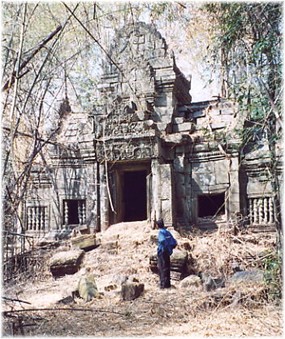
Certainly our best temple find was the one shown above, at Prasat Chean Sram, some two kilometres outside the village of Prey Veng, some 3o kms northwest of the Koh Ker complex. Travel in that part of the province is only by moto, ox-cart or occasionally by 4WD in the dry season. We went by moto and it was a tough ride but well worth the effort. The temple itself was a real gem, demined only a year before and still housing numerous beautifully-carved lintels on both its two entrance gates and on its five brick towers. Its a large site, surrounded by thick bamboo and with a lot of undergrowth to battle against. The photo above shows Sokhom admiring the imposing East Gopura, with its delicate sandstone carvings. Our guide from the village was Tel, a 40 year old former Khmer Rouge fighter, who told us all about his decade with the guerilla group over our chicken and rice lunch next to the large baray nearby. Then we moved onto the village of Yeang, where we stayed overnight with a wonderful family, who like most of the 77 families in the village, were formerly in the ranks of the Khmer Rouge. Phearng and his wife Sinoun were superb hosts and the next day we went out to find two more temple sites, Prasat Dap and Prasat Bei with Phearng and his pal, Norn.
Temple-hunting in this part of the country is very tough and uncomfortable, certainly not everyone's idea of fun, but for me the rewards are enormous. Not only do I get to see temple sites not seen by western eyes for many decades but I get to spend time with some of the most welcoming and down to earth people you'd ever wish to meet. For me, this is exploring Cambodia at its finest.
Here's a quick link to my Cambodia Tales.
Friday, April 06, 2007
Angkor National Museum
According to their website, the Angkor National Museum (ANM) should be opening its doors this month. However, whether it will be the only museum in Siem Reap is up for debate. There's talk of Korean investment being directed to a second museum at the grounds of the Angkor Conservation compound and a third to be built with Japanese investment. Included in the ultramodern new building you can see on the main road to the Angkor complex, will be a cultural mall which will house restaurants, shops, a library and a spa. There is much debate at all levels and sighs of anguish already, with the suggestion that up to 700 items have been earmarked to be removed from the National Museum in Phnom Penh and transported to Siem Reap to help populate the new ANM. That fact that a Thai company has been responsible for the construction of the new building has also left a sour taste in the mouths of many. Whether the ANM does open its doors on time, we shall see, but the arguments for and against this new visitor attraction (set to cost foreign tourists $13 to enter) will rage on for a long time to come I'm sure.