Sunday, July 30, 2006
Last Seen At Angkor
Khmer Rouge culpability
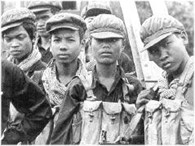
Crimes committed after 1979 will not come under scrutiny. Which means that the perpetrators of the murder of British de-miner Christopher Howes, will not face trial unless brought to book by the existing Cambodian legal system. Howes, and his Khmer interpreter Houn Hourth, were captured and killed by the Khmer Rouge in March 1996. Eyewitness testimony suggests that the order to murder Howes came from the recently deceased warlord Ta Mok but was allegedly carried out by men under his command near the northern Khmer Rouge stronghold of Anlong Veng. To-date, no-one has been charged with the Howes murder.
Part of My Soul - Loung Ung
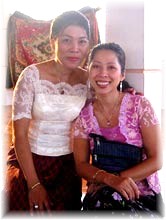
The photo above shows Loung and her older sister Chou (in white), reunited in Cambodia. The NHK (Japan's National Public Broadcaster) documentary was called First They Killed My Father. An interview with the producer/director of the NHK program, Kayoko Mitsumatsu, can be viewed here. The photo of Loung below, taken by Gigi Cohen, appeared in the Sunday Times magazine in April 2000.

Saturday, July 29, 2006
The Haing Ngor Foundation
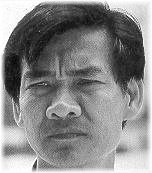
You can read all about Haing S Ngor at the website of the Foundation set up in his name, haingngorfoundation.org.
Visit my Killing Fields webpage for more on the film of the same name.
Friday, July 28, 2006
Theary Seng : KR Tribunal Watch
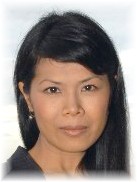
A 25-minute video interview with Ms Seng (pictured) can be seen on the BBC's HARDtalk news programme website here, where she describes her life under the KR and the heart-wrenching loss of both of her parents.
* * * * *
The Khmer Rouge Tribunal is mentioned in nearly every news story coming out of Cambodia in the last few weeks. The judges were sworn in recently and now the case is being put together to decide who the Tribunal will actually put on trial (aside from Ta Mok who died a few days ago, and Comrade Duch, who's already in custody), with proceedings expected to begin sometime in 2007. Personally, I don't feel that trying just a handful of the very top former KR leaders from the Central Committee is enough. I think it should be extended to at least another tier of leadership, if not two, including Zone and Military Commanders where there is evidence of their wrong-doing.
To read an interesting and factual introduction to the Tribunal, go to the DC-Cam website here.
Tang Kim's evidence
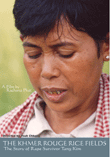
Rape crimes by the Khmer Rouge have been largely forgotten or ignored - only 168 cases of rape committed against women during the murderous regime have been identified by DC-Cam - with Tang Kim being the first survivor to have her experiences properly documented. The Khmer Rouge prided themselves on adhering to a strict code of sexual conduct during their otherwise brutal rule from 1975 to 1979. However, Tang Kim, 51 and now a nun, recounts in the film that three days after the Khmer Rouge killed her first husband in May 1975, she and seven other women were rounded up by the regime's soldiers to be raped and then murdered near a village in Kompong Chhnang. Rachana Phat said Tang Kim was reluctant to talk about her own agony until she was convinced how important it would be for educating a new Cambodian generation about the extent of the Khmer Rouge's inhumanity.
Wednesday, July 26, 2006
The Ponheary Ly Foundation
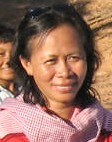
Reading the website of the Ponheary Ly Foundation adds another dimension to the guiding work this former teacher is doing, and that is providing supplies for the school-children around Siem Reap. Bottom-line is $12 buys the necessary items for one child for one year. I haven't met Ponheary Ly (pictured) myself but suggest you have a look at the website set up by two American travelers who state they've seen some of the world, but no destination left an impact quite like Cambodia, and no people ever affected us in quite the same way. They speak very highly of her, as do many other satisfied travellers on various forums and websites. However, if you don't want to hire her for her guiding qualities, perhaps you can consider the worthy cause she promotes in support of the primary school kids in and around Siem Reap.
Read more about the Ponheary Ly Foundation here.
There are a plethora of charities, foundations and people doing great work in Cambodia. This appears to be one such organisation. Another one is the Schools for Children of Cambodia, who are holding an informal gathering on Saturday 5 August in London to update their supporters and volunteers on their current projects. Their Cambodia country Manager Rachel Palmer will be there on a brief visit to the UK, as will actress Cathy Shipton who has recently returned from filming in Cambodia. During her trip Cathy took some time out to visit one of their schools where she spent an afternoon meeting the children and staff, and she'll provide the meeting with an update of her trip and her experiences during her stay in Cambodia. The website for SCC is at sccambodia.org.
Saturday, July 22, 2006
Remembering Christopher Howes
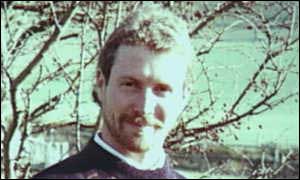
Christopher was a landmine specialist working for the Mines Advisory Group a few miles north of Siem Reap in the village of Preah Ko when he and his twenty-strong de-mining unit were abducted at gunpoint by Khmer Rouge cadre in March 1996. Told to return to his base for ransom money, Christopher selflessly refused so he could remain with his team and negotiate their safety. Instead the guerrillas released his team but kept the Bristol-born former Royal Engineer hostage for a few more days before he was executed. However, his fate remained a mystery for more than two years until evidence emerged in May 1998 that he was taken to Anlong Veng and shot twice on the orders of Ta Mok by men under his command.
Throughout those two years, numerous stories emerged to suggest Christopher was still alive. These included declarations from First Prime Minister Norodom Ranariddh that he'd escaped and was on his way to freedom, and others that photos proved he was alive and well or that the soldier-turned-deminer was being forced to teach the guerrillas how to make their own mines. He was reported to be suffering from malaria and chronic diarrhea and in November 1996 his employers, MAG, reportedly paid $120,000 to a man who claimed he could gain his release but then vanished with most of the money. Each story turned out to be a cruel fabrication until May 1998, when Scotland Yard detectives recovered ashes from the site where Christopher's body had been cremated. His was not the only death around that time - between the period 1994 to 1998 the Khmer Rouge abducted and killed at least ten foreign tourists.
Christopher had served with the Royal Engineers for seven years prior to his three year association with MAG, initially in northern Iraq and then in Cambodia for just five months before his abduction. An acknowledgement of his humanitarian work and bravery in negotiating the release of his men was honoured with the naming of a Phnom Penh street after him and the posthumous award of the Queen's Gallantry Medal in 2001. A memorial service was held in his home village of Backwell near Bristol in July 1998, once his parents had received confirmation of Christopher's death from Scotland Yard and Foreign Office officials. At the service, Rae McGrath, founder of MAG, said: "Having known Chris as a friend and as a colleague I cannot find it within me to mourn. I will celebrate a heroic friend, a deminer who put into practice his engineering skills to make this world a better place and who, at the cost of his life, showed his love to and loyalty for his fellow men." Click here to read a collection of news reports following the abduction.
The Pepy Ride folks

After our meeting in Battambang, I had the opportunity to stop by the Pepy Ride school in Chanleas Dai on my way north to Samraong a few days later. Here's a photo of me next to the mural that the cyclists, children and other volunteers painted to record the official opening of the school building.

More recommendations for Heang
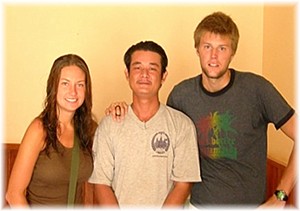
Heang, as well as appearing on my own website under my recommended guides webpage, has also found support from people like Kim Cooper and more recently Fred Sun, who's set up a website to sing his praises. And rightly so. Heang is someone who helps you to enjoy the sights, sounds and smells of Cambodia and its people because it means as much to him as it does to you.
Subscribe to:
Posts (Atom)
