I've been a busy bee, with three books on the go at once including reading a friend's excellent manuscript for an historical novel which I hope will come out sometime next year. More nearer the time. One of the books I've just finished is John Tully's A Short History of Cambodia: From Empire to Survival, and I really enjoyed it. The author's style was engaging and easy to follow, not heavy at all and its intended audience - tourists, students and general readers with an interest in SEAsia - will gain much from his concise interpretation of Cambodia's chequered history, which is awash with war, invasion and conflict. Throughout, you can't but feel for the Khmer people who've borne the brunt of so much for so long.
The book, published by Allen & Unwin, is 270 pages long. Its not as detailed as David Chandler's History of Cambodia but its not intended to be and hits the spot perfectly in my view. Interestingly, Dr Tully is a lecturer at the Victoria University in Melbourne and pays his dues to his former tutor, David Chandler, acknowledged as the great Cambodian historian. In my opinion, he does a fine job following in his mentor's footsteps. You can get the book here.
Sunday, August 27, 2006
Bookends
Saturday, August 26, 2006
Bombhunters in Cambodia
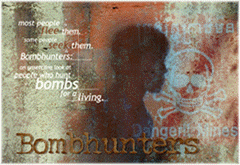
Independent film producer Skye Fitzgerald's film, Bombhunters, explores the long-term consequences of war and genocide in Cambodia that persist in the form of landmines, unexploded ordnance (UXO), and other munitions. In particular, his film examines the social, cultural, and historical context and experiences of rural villagers who risk their lives to seek out and dismantle UXO to sell the scrap metal for profit.
Fitzgerald did much of his filming in Kompong Thom province and includes in his 85-minute film people like Khmer activist Ronnie Yimsut alongwith Aki Ra, a popular former soldier who lives in Siem Reap and has his own landmine museum; Yun Te, whose wife nearly bursts from anxiety, worrying aloud how their two baby girls can survive if her husband loses his arms, his legs, or his life; Salot Vuthee, whose husband lost all of those one unlucky afternoon; and Pon Lok, a handless 13-year-old whose face, neck, and chest are pocked with open and angry shrapnel wounds. Ronnie Yimsut summed up the film thus: "Skye and his film crew, in my eyes at least, are champions for those little people who lack voice. It took courage, but more importantly, it took a strong passion to make this kind of film to educate the public."
Bombhunters is currently showing at film festivals across the United States and earning rave reviews, whilst Fitzgerald is hopeful it will receive wider global distribution. Read more about the film, here.
Thursday, August 24, 2006
The Redlight Children Campaign
The people that put together the K11 Project - they've produced 3 films focusing on child trafficking and prostitution in SEAsia and particularly Cambodia - have also initiated The Redlight Children Campaign. The intention is to generate conscious concern and inspire immediate action against child sexploitation. It's a worldwide grassroots initiative whose mission is to reduce the number of children sold to the sex industry and exploited on the internet. You can find out more by clicking here. As for the K11 Project, the 60th Edinburgh International Film Festival last week was the stage for the world premier of the film Holly (pictured), and it earned rave reviews as a result. Certainly the K11 Project team are hell-bent on telling their story and getting their message to the masses. Read more here.
Tuesday, August 22, 2006
Chris Moon in Kidnapped
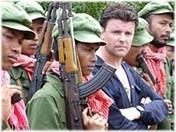
In 1993 ex-soldier and landmine specialist Chris Moon was working with HALO Trust in Cambodia and was kidnapped by the Khmer Rouge whilst de-mining in a remote area. The story of his kidnap, survival and eventual release is told in a new Channel 4 documentary, Kidnapped in the Killing Fields, which will be shown on British television on 10 September 2006 at 8pm as part of the Alive series. Actors will re-enact the scenes (pictured above), which bear a remarkable similarity to the abduction of de-miner Christopher Howes just three years later. Unfortunately for Howes, the result was not the same.
In the case of Chris Moon, he went onto work with HALO in Mozambique, but while on duty he was blown up by a mine and lost his lower right leg and right arm. Since that time, Moon has inspired many with his incredible determination to overcome his disability - he completed the London Marathon less than a year after leaving hospital - and has worked tirelessly for the British charity, The Cambodia Trust. In fact, Moon is taking part in a sponsored bike ride beginning on 31 August when he will cycle across Cambodia on a specially adapted bicycle to raise funds for the charity. You can find out more here.
The Cambodia Trust is a charity that I've personally supported in the past and who've done amazing work in Cambodia and beyond. Meanwhile, to find out more about Chris Moon, go to his own website at www.chrismoon.co.uk.
Monday, August 21, 2006
Tuol Sleng Survivors
The above photo is reproduced courtesy of DC-Cam and shows a group of survivors from the 20,000 prisoners that were incarcerated in the Tuol Sleng interrogation centre in Phnom Penh between 1975 and 1979. DC-Cam investigations suggest up to fourteen prisoners managed to survive the extermination at the centre though at the time this photo was taken in 1979, only seven had been identified. They were: [RtoL] Chum Mey, Ruy Neakong*, Im Chan*, Vann Nath, Bou Meng, Phan Than Chan* and Ung Pech*. Only three of those pictured survive today - Chum Mey, Vann Nath and Bou Meng.
I've just watched all of John Pilger's documentaries on Cambodia and one of the original survivors, Ung Pech, was interviewed by Pilger for his first programme, Year Zero. Pech, whose life was spared because of his skill as a mechanic, became the first Director of Tuol Sleng when it opened to the public as a Genocide Museum on 7 January 1980, a year after its liberation. In the interview he described how he lost his wife and five children to starvation and how he himself was tortured. Ung Pech remained as Director until the early '90s and passed away in late 1996.
Saturday, August 19, 2006
Cyclo Centre's Mekong Bike Ride
An old friend, Hallam Goad, has sent me this invitation to take part in a bike ride to raise funds for the Cyclo Centre Phnom Penh, a day centre for cyclo drivers which provides washing facilities, medical care and opportunities for them to learn a variety of skills. The adventurous challenge is to cycle the 629 kilometres between Kampot and Stung Treng over a period of 8 days in early December this year. Unfortunately I can't make it - as I'm not quite that mad, yet - but if you are interested in getting involved, or finding out more about the Cyclo Centre, contact Hallam on (Cambodia) 012 360472 or by email: hallam@camintel.com. They also have a website here.
Whilst the exact number of cyclo drivers in Phnom Penh is not precisely known because of the itinerant nature of the work, more than 1,300 are regular users and beneficiaries of the Cyclo Centre, which impressed the hell out of me.
Friday, August 18, 2006
The New Internationalist - April 1993
A special issue of The New Internationalist magazine that came out in April 1993 was edited by journalist John Pilger and titled Cambodia - Return to Year Zero. You can read the main articles from the issue on-line here. It gives you a flavour of the recent past and present at that time and looked nervously into the future in the run up to the UN-sponsored elections that were due the following month. It also shared the same title as John Pilger's sixth documentary film that he and David Munro had made about Cambodia and which aired on British tv on 20 April and thereafter in some 30 countries. The main thrust of the documentary was the warning that the Khmer Rouge could be on their way back to power after the United Nations had legitimized those responsible for the 'killing fields'. Included in the contents were articles by Ben Kiernan, Paul Donovan, Chanthou Boua, Joan Healy and Pilger himself.
Thursday, August 17, 2006
Bare Hands and Wooden Limbs
A brand new hour-long documentary called Bare Hands and Wooden Limbs: Healing, Recovery and Reconciliation in Cambodia by director Alison McMahan (pictured) explores the relationships between former enemies working together to make possible the community of Veal Thom, a cooperative village composed primarily of disabled veterans, from both sides of the war, and their families. The amputees of Veal Thom cope with extreme poverty, the elements, poor health, lack of education and lack of resources, though by working together the amputees make their village blossom. The film is currently being shown at film festivals in the United States. Read more about the film at the official website.
Its the second film by director Alison McMahan on the villagers of Veal Thom. Her previous film, Cambodia: Living with Landmines showed the human cost of landmines and the courage and persistence of the villagers as they build a new life for themselves. The village of Veal Thom is also featured in the book, Cambodia Now, by author Karen J Coates. Her book reveals the story of amputee Bun Na and his journey to overcome a life of begging on Phnom Penh's streets to his successful integration into the village of Veal Thom.
Wednesday, August 16, 2006
Forced repatriation in Sentenced Home
David Grabias and Nicole Newnham (pictured) combined the production, direction and writing of the story of the forced repatriation back to Cambodia of three young Cambodian Americans in their 80-minute documentary film, Sentenced Home, which has been showing in film festivals in recent months. Loeun Lun, Manny Uch and Kim Ho Ma arrived in the US as refugees in the ‘80s, and settled in Seattle, though each was drawn into gang life, and ultimately jail. According to US immigration law they should have been deported, but Cambodia did not accept deportees at the time of their sentences. However, after September 2001, the US pressured Cambodia into changing its policy; as a result over 1,400 individuals are on the list to be separated from their families and returned to a land that many barely know. Despite having served their time in jail, two of the three youngsters have already been deported and following them from the States to Cambodia, Grabias and Newnham bring to light their heart-breaking stories, and reveal the human cost of this decision to repatriate. Once they reach Cambodia, Bill Herod coordinates the Returnee Assistance Project, a network that helps provide employment, training and accommodation for the returnees.
Tuesday, August 15, 2006
Rithy Panh - giving his people a voice
Rithy Panh's body of work as an internationally-renowned film-maker bears witness to the devastation that the Khmer Rouge wreaked upon the Cambodian people and allows the survivors to tell their own stories. Himself a survivor and refugee, Panh (pictured) gives his countrymen a voice and an opportunity to come to terms with their own horrific past whilst documenting their memories. His feature films and documentaries are an integral part of the healing process and as such, are recommended viewing for anyone with a smidgen of interest in Cambodia.
Panh was born in 1964 and found himself an orphan, having lost most of the members of his family to the Khmer Rouge genocide, by the time he arrived in a refugee camp in Thailand in 1979. France was his next destination, where he dabbled in painting and writing before discovering a penchant for film-making and gained entry into a prestigious film school in his adopted country. In 1989 he returned to the Thai-Cambodian border to make his first documentary, filming the troubled lives of the Khmer refugees in Site 2. He followed that up with two feature films, Rice People and One Evening After The War, and documentaries such as Bophana and Land of Wandering Souls amongst others. In 2003 he released the unforgettable S21 - The Khmer Rouge Killing Machine, which saw two survivors of the extermination and torture centre confront some of their guards and jailers at the scene of their imprisonment.
Earlier this year, Panh's latest work appeared in film festivals such as the Barcelona festival in May. Burnt Theatre is a blend of documentary, fiction and performance and follows five artists searching to express themselves, with the main setting being the former national theatre, which was burnt down a decade ago. Panh, who splits his time between Paris and Cambodia, is desperately keen to train and support film-makers and technicians in his own country as well as being actively engaged in promoting and building an audiovisual resource archive in Phnom Penh.
Read more about Rithy Panh and his work here.
